
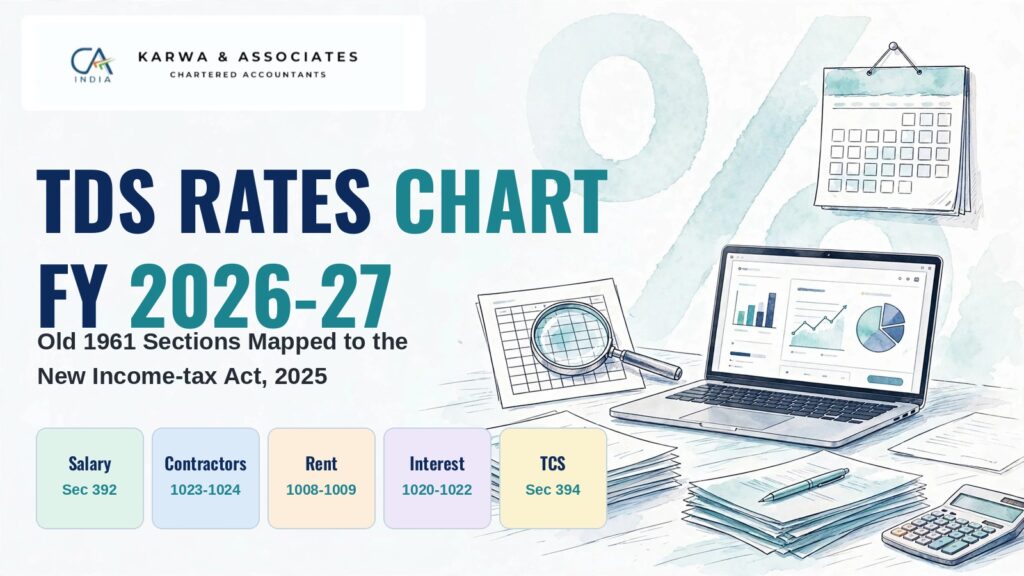
From 1 April 2026, the Income-tax Act, 2025 has replaced the Income-tax Act, 1961, and every TDS and TCS section number your team knows by heart has changed. Salary TDS now sits in section 392, almost every other payment sits in one consolidated section 393 with a four-digit payment code, and TCS sits in section 394. This TDS rates chart FY 2026-27 maps each old section to its new section and payment code, with the threshold limit and rate that apply from Tax Year 2026-27, so your challans and quarterly statements pass validation the first time.
The rates and most limits will look familiar, because they largely continue from last year. What has changed is the address of every provision. A return that quotes section 194C or 194J for a payment made on or after 1 April 2026 will fail validation, and the same payment reported under the wrong new code can attract fee, interest and notice. Keep this TDS rates chart FY 2026-27 next to your accounting software until the new numbers become habit.
Source: Income-tax Act, 2025 (Act No. 30 of 2025), sections 392, 393 and 394, read with the Income-tax Rules, 2026 and CBDT clarifications, as published by the Income Tax Department at incometaxindia.gov.in. Rates for TCS goods are as amended by the
Finance Act, 2026.
Table of Contents
TDS rates chart FY 2026-27: what changed from 1 April 2026
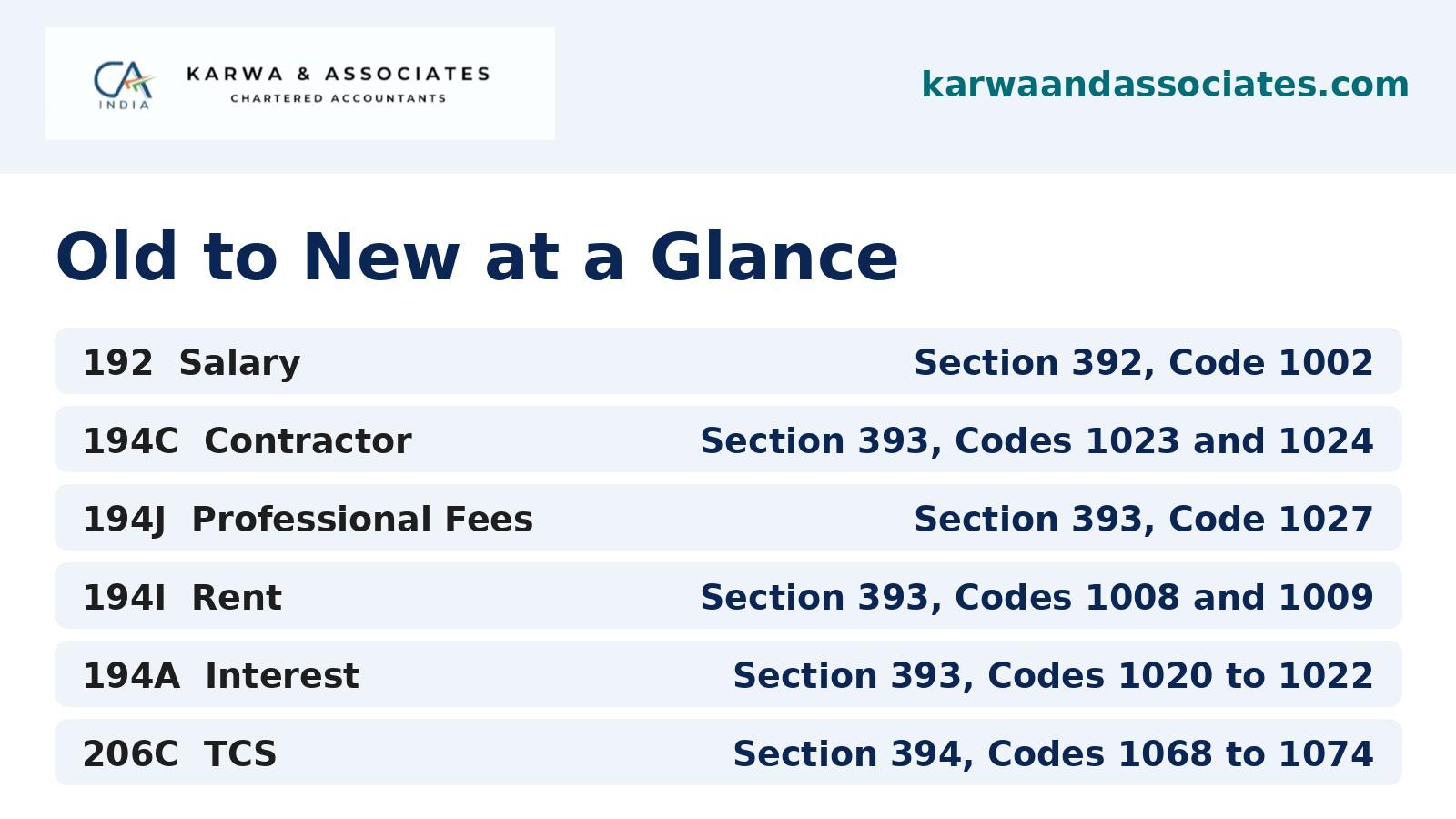
- Three sections do the work of thirty. Old sections 192 to 194T are consolidated into section 392 (salary), section 393 (other payments to residents, non-residents and any person) and section 394 (TCS, old section 206C).
- Every payment has a four-digit code. The code, not the old section number, is what you select in Challan 281 and in the quarterly statement. Codes run from 1001 onwards.
- Returns have new form numbers. Form 24Q is now Form 138, Form 26Q is now Form 140, Form 27Q is now Form 144 and Form 27EQ is now Form 143. Certificates are renumbered too: Form 16 is now Form 130, Form 16A is now Form 131 and Form 27D is now Form 133.
- TCS rates on goods are now a flat 2 percent. The Finance Act, 2026 rationalised the section 394 table: scrap and alcoholic liquor moved up from 1 percent to 2 percent, tendu leaves came down from 5 percent to 2 percent, and timber, forest produce and minerals sit at 2 percent.
- TCS return dates now match TDS dates. The old Form 27EQ calendar of the 15th is gone. All quarterly statements, TDS and TCS, are due on 31 July, 31 October, 31 January and 31 May.
- Old provisions still govern old payments. If the credit or payment happened on or before 31 March 2026, the 1961 Act sections and old form numbers apply to that transaction, even if you deposit or report it later.
Who must deduct: companies, firms and LLPs deduct tax under these provisions from their first day of operation. Individuals and HUFs come under most of these provisions when their business turnover exceeded ₹1 crore, or their professional gross receipts exceeded ₹50 lakh, in the previous financial year, which are the tax audit limits. Specific payments such as salary, rent under the personal rent provision and purchase of property have their own applicability rules.
TDS rates chart FY 2026-27 for salary, rent, contractors and professionals
The table below is the working core of this TDS rates chart FY 2026-27. It covers the payments that make up almost all deductions for a typical business. Read it as: find the payment, note the new section and code, check the limit, apply the rate.
| Old section (1961 Act) | New section (2025 Act) | Payment code | Nature of payment | Threshold limit | Rate |
|---|---|---|---|---|---|
| 192 | 392 | 1002 | Salary paid to employees other than Government employees | TDS at slab rates on salary above the basic exemption limit (₹4 lakh under the new regime), after rebate under section 87A where applicable | Slab rates |
| 194D | 393(1) [Table: Sl. No. 1(i)] | 1005 | Insurance commission | ₹20,000 | 2% |
| 194H | 393(1) [Table: Sl. No. 1(ii)] | 1006 | Commission or brokerage, other than insurance commission | ₹20,000 | 2% |
| 194I(a) | 393(1) [Table: Sl. No. 2(ii).D(a)] | 1008 | Rent for plant, machinery or equipment | ₹50,000 per month | 2% |
| 194I(b) | 393(1) [Table: Sl. No. 2(ii).D(b)] | 1009 | Rent for land or building, or land appurtenant to a building, or furniture and fittings | ₹50,000 per month | 10% |
| 194A | 393(1) [Table: Sl. No. 5(ii).D(a)] | 1020 | Interest on bank, co-operative bank or post office deposits, where the payee is a senior citizen | ₹1,00,000 | 10% |
| 194A | 393(1) [Table: Sl. No. 5(ii).D(b)] | 1021 | Interest on bank, co-operative bank or post office deposits, other cases | ₹50,000 | 10% |
| 194A | 393(1) [Table: Sl. No. 5(iii)] | 1022 | Interest on deposits or loans paid by any other payer, such as a company, NBFC or private lender | ₹10,000 | 10% |
| 194C | 393(1) [Table: Sl. No. 6(i).D(a)] | 1023 | Payment to a contractor or sub-contractor, where the contractor is an individual or HUF. Covers job work, repair, labour contracts, supply of labour, advertisement, freight and shipping charges and annual maintenance contracts | ₹30,000 for a single payment and ₹1,00,000 in aggregate | 1% |
| 194C | 393(1) [Table: Sl. No. 6(i).D(b)] | 1024 | Payment to a contractor or sub-contractor, where the contractor is any other person | ₹30,000 for a single payment and ₹1,00,000 in aggregate | 2% |
| 194J | 393(1) [Table: Sl. No. 6(iii).D(a)] | 1026 | Fees for technical services, royalty for sale, distribution or exhibition of cinematographic films, and payments to a call centre operator | ₹50,000 | 2% |
| 194J | 393(1) [Table: Sl. No. 6(iii).D(b)] | 1027 | Fees for professional services | ₹50,000 | 10% |
| 194J | 393(1) [Table: Sl. No. 6(iii).D(b)] | 1028 | Remuneration, fees or commission paid to a director of a company, other than salary | No threshold | 10% |
| 194 | 393(1) [Table: Sl. No. 7] | 1029 | Dividend | ₹10,000 | 10% |
| 194Q | 393(1) [Table: Sl. No. 8(ii)] | 1031 | Purchase of goods. Applies only to a buyer whose turnover exceeded ₹10 crore in the previous financial year | On purchases from a seller exceeding ₹50 lakh in the current financial year | 0.1% |
| 194T | 393(3) [Table: Sl. No. 7] | 1067 | Salary, remuneration, commission, bonus or interest paid by a firm to a partner of the firm. Applies only to partnership firms and LLPs | ₹20,000 in a financial year | 10% |
Note for transporters: no TDS is required on payments to a transporter engaged in plying, hiring or leasing goods carriages, where the transporter owned ten or fewer goods carriages at any time during the previous year and furnishes a declaration along with PAN.
Note on interest: the old single line for interest misleads many teams. Under the new Act the limit depends on who pays and who receives. A senior citizen earning bank interest has a limit of ₹1,00,000 (code 1020), other bank depositors have ₹50,000 (code 1021), and interest from a company deposit, NBFC or private loan carries a limit of only ₹10,000 (code 1022). All three are taxed at 10 percent once the limit is crossed, on the full amount, not only on the excess.
TDS rates chart FY 2026-27: TCS rates under section 394
TCS is collected by the seller from the buyer on specified goods. Section 394(1) of the new Act carries the old section 206C(1) list, and after the Finance Act, 2026 the rate on every goods row in this part of the TDS rates chart FY 2026-27 is a flat 2 percent, with no threshold limit.
| Old section (1961 Act) | New section (2025 Act) | Payment code | Nature of receipt | Person responsible for collection | Rate |
|---|---|---|---|---|---|
| 206C(1) | 394(1) [Table: Sl. No. 1] | 1068 | Sale of alcoholic liquor for human consumption | Seller | 2% |
| 206C(1) | 394(1) [Table: Sl. No. 2] | 1069 | Sale of tendu leaves | Seller | 2% |
| 206C(1) | 394(1) [Table: Sl. No. 3] | 1070 to 1072 | Sale of timber obtained under a forest lease or otherwise, and any other forest produce obtained under a forest lease | Seller | 2% |
| 206C(1) | 394(1) [Table: Sl. No. 4] | 1073 | Sale of scrap | Seller | 2% |
| 206C(1) | 394(1) [Table: Sl. No. 5] | 1074 | Sale of minerals, being coal, lignite or iron ore | Seller | 2% |
Section 394 also continues TCS on the sale of a motor vehicle where the value exceeds ₹10 lakh, at 1 percent, and on parking lots, toll plazas and mining or quarrying rights, remittances under the Liberalised Remittance Scheme and overseas tour packages, each with its own threshold and rate in the section 394 table. Businesses dealing in these items should read the full table before invoicing.
TDS rates chart FY 2026-27: payment and return due dates
Deposit the tax first, then file the statement. Under this TDS rates chart FY 2026-27 calendar, TDS and TCS deducted or collected from April to February must be deposited by the 7th of the next month. For March, TDS must be deposited by 30 April, while TCS for March must be deposited by 7 April.
| Statement | Old form | New form | Q1 (Apr to Jun) | Q2 (Jul to Sep) | Q3 (Oct to Dec) | Q4 (Jan to Mar) |
|---|---|---|---|---|---|---|
| Salary TDS statement | 24Q | 138 | 31 July | 31 October | 31 January | 31 May |
| TDS statement, payments to residents other than salary | 26Q | 140 | 31 July | 31 October | 31 January | 31 May |
| TDS statement, payments to non-residents | 27Q | 144 | 31 July | 31 October | 31 January | 31 May |
| TCS statement | 27EQ | 143 | 31 July | 31 October | 31 January | 31 May |
After filing, issue certificates in the new series: Form 130 for salary (was Form 16), Form 131 for other TDS (was Form 16A) and Form 133 for TCS (was Form 27D). Our advance tax calculator helps you plan the related advance tax instalments for the year.
TDS rates chart FY 2026-27 in practice: three worked examples
Example 1, professional fees. Your company pays a consultant ₹80,000 for professional services in May 2026. The payment crosses the ₹50,000 limit, so deduct 10 percent, which is ₹8,000, under section 393(1) with payment code 1027, pay the consultant ₹72,000, deposit ₹8,000 by 7 June 2026 and report it in Form 140 for Q1.
Example 2, two kinds of rent. Your firm pays office rent of ₹60,000 a month and hires plant and machinery at ₹40,000 a month. The office rent crosses the monthly limit of ₹50,000, so deduct 10 percent, which is ₹6,000 a month, under code 1009. The machinery hire is below the monthly limit, so no TDS is deducted on it under code 1008 until the monthly payment crosses ₹50,000.
Example 3, partner interest. An LLP credits ₹50,000 as interest on capital to a partner during the year. The amount crosses the ₹20,000 yearly limit, so the LLP deducts 10 percent, which is ₹5,000, under section 393(3) with payment code 1067, and reports it in Form 140. Share of profit remains outside this provision.
Common mistakes that bring notices
- Using the old section in a new-period return. For payments on or after 1 April 2026, quote the section 392, 393 or 394 code. Old codes belong only to periods up to 31 March 2026.
- Picking the wrong interest code. Codes 1020, 1021 and 1022 turn on the payer and the payee, not on the word interest. Map each interest ledger to its code once, in writing.
- Ignoring the no-PAN rule. Where the payee does not furnish PAN, tax is deducted at the higher rate under section 397(2) of the new Act (the old section 206AA), generally 20 percent.
- Filing TCS on the old 15th dates. Form 143 now follows the same quarter-end dates as TDS statements.
- Not updating software masters. Tally, ERP and payroll masters, vendor onboarding forms and standing instructions to banks all carry section references. Update them once, centrally, and keep a copy of this TDS rates chart FY 2026-27 with the updated master list.
For businesses in Jaipur and across India
Most of the migration work is one-time: remap the payment codes in your accounting system, correct the vendor masters, and brief whoever prepares the challan. Our team at Karwa & Associates completes this migration for Jaipur businesses as part of monthly accounting and compliance retainers, and supports clients across India remotely. If your Q1 or Q2 statement for Tax Year 2026-27 was filed with old codes, speak to us before the next quarter so the correction is planned, not penal. Readers tracking other 2026 changes may also read our guide to the GST amendments effective 1 November 2026. Prefer to search instead of reading a chart? Use our TDS / TCS rate finder to look up any payment, old section or new section in seconds.
FAQs
What is the new section for old section 194C?
Contractor payments now sit in section 393(1) of the Income-tax Act, 2025. Use payment code 1023 at 1 percent where the contractor is an individual or HUF, and code 1024 at 2 percent for other contractors, with the same limits of ₹30,000 for a single payment and ₹1,00,000 in aggregate.
Have TDS rates changed in FY 2026-27?
For most payments, no. The rates and limits largely continue. The real change is structural: new section numbers, four-digit payment codes and new form numbers. TCS on specified goods is the exception, where the Finance Act, 2026 set a flat rate of 2 percent.
Which form replaces Form 26Q?
Form 140 replaces Form 26Q for quarterly TDS statements on payments to residents other than salary, for periods from 1 April 2026. Salary moves from Form 24Q to Form 138, and the TCS statement moves from Form 27EQ to Form 143.
What happens if I deduct using the old section code?
The statement can fail validation, and a wrong code can lead to fee for late filing, interest and a correction cycle. Old codes remain correct only for transactions up to 31 March 2026.
Does the TDS rates chart FY 2026-27 cover salary?
Yes. Salary TDS is now under section 392 with payment code 1002 for employees other than Government employees, deducted at slab rates on salary above the basic exemption limit, taking the section 87A rebate into account where it applies.
Conclusion
The new Act did not change what you deduct on most payments. It changed where every provision lives and how you report it. Print this TDS rates chart FY 2026-27, remap your codes once, and Tax Year 2026-27 compliance becomes routine again. For a review of your TDS migration, or for monthly accounting, payroll and return filing handled end to end, contact Karwa & Associates.
About the Author
This chart is prepared and maintained by Karwa & Associates, Chartered Accountants, a Jaipur based firm established in 1991. The firm serves clients across India and globally in taxation, accounting, audit and business advisory. This article is general information on the Income-tax Act, 2025 and is not a substitute for advice on your specific facts.

CA Anshul Karwa is a Chartered Accountant (DISA-qualified) and Partner at Karwa & Associates, Chartered Accountants, Jaipur. A non-commerce student who cleared CA in the first attempt, he worked with Big 4 firms and MNCs before joining the firm. He also builds digital apps, websites and tools for CAs, founders and other professionals, and writes books on investing.