
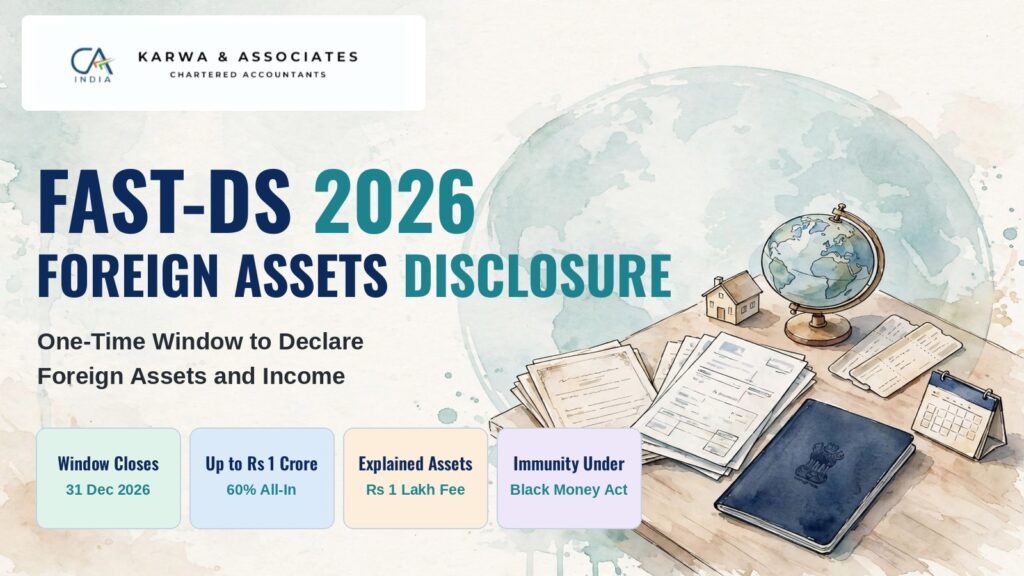
Many Indians hold a foreign asset they never reported: a bank account left open after a student year abroad, ESOPs or RSUs from a foreign employer, a 401(k) left behind after moving back, or a small property bought overseas. FAST-DS 2026 is the Government’s one-time window to bring such assets and income on record, pay a defined amount, and close the matter under the Black Money Act.
The window is short: declarations can be filed only between 16 August 2026 and 31 December 2026. This guide explains who can use FAST-DS 2026, what it costs, how valuation works, which forms and deadlines apply, and what immunity you get, and what you do not.
Read the primary documents first: the CBDT’s official FAQs, the supplementary FAQs dated 20 November 2026 and the scheme Rules, notified as Notification No. 114/2026 (G.S.R. 732(E)). Every figure here comes from the Finance Act, 2026, those Rules and the FAQs.
Table of Contents
FAST-DS 2026 Basics: What the Scheme Is
1. What is FAST-DS 2026? The Foreign Assets of Small Taxpayers Disclosure Scheme, 2026 is a one-time voluntary disclosure scheme. It lets an eligible taxpayer declare a foreign asset located outside India, or foreign income never offered to tax or reported in a return. The taxpayer pays the prescribed amount and gets immunity from further tax, penalty and prosecution under the Black Money Act, 2015 for what was declared.
2. What is the legal basis? The scheme sits in Chapter IV of the Finance Act, 2026, sections 130 to 144. The working rules are the Foreign Assets of Small Taxpayers Disclosure Scheme Rules, 2026, notified as Notification No. 114/2026 dated 14 August 2026 (G.S.R. 732(E)) under section 143, in force from 16 August 2026.
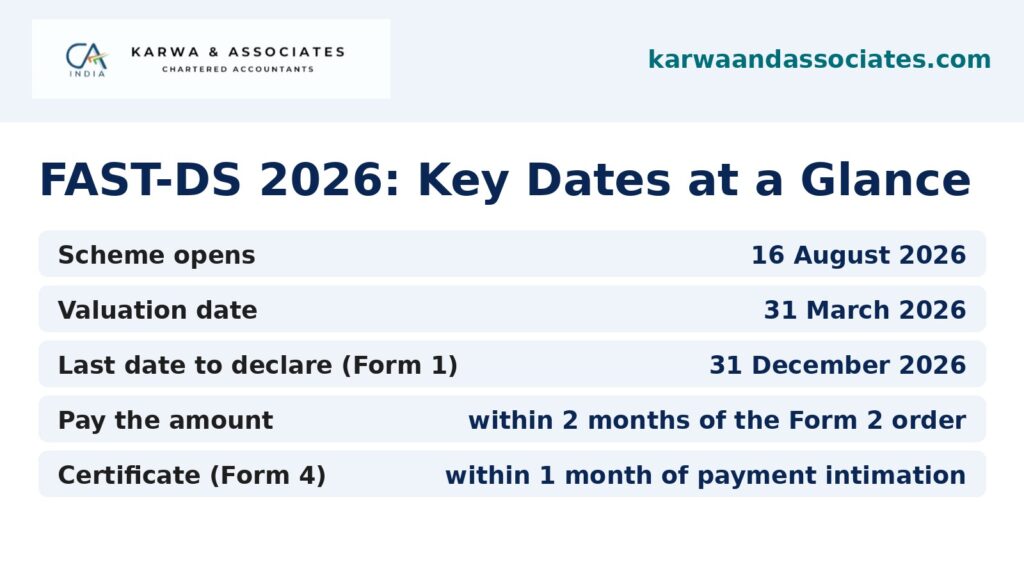
3. What are the key dates? The window runs from 16 August 2026 to 31 December 2026, and all assets are valued as on 31 March 2026. Payment and the certificate follow a fixed timetable, set out next.
FAST-DS 2026 Key Dates You Cannot Miss
Every FAST-DS 2026 date below comes from the Rules and the CBDT FAQs. The filing deadline is fixed. The later dates run off the month you file or receive the order, so file early if you can.
| Event | Date or deadline |
|---|---|
| Scheme announced in the Union Budget 2026-27 | 1 February 2026 |
| Rules notified (Notification No. 114/2026, G.S.R. 732(E)) | 14 August 2026 |
| Declaration window opens | 16 August 2026 |
| Valuation date for all assets | 31 March 2026 |
| Last date to file the declaration (Form 1) | 31 December 2026 |
| Authority’s order of the amount payable (Form 2) | Within one month from the end of the filing month |
| Payment of the amount in the Form 2 order | Within two months from the end of the month the order is received |
| Late payment window | Up to two further months, at simple interest of 1 percent per month or part of a month |
| Outer limit for payment | Four months from the end of the month of the Form 2 order; later payment loses the benefit |
| Intimation of payment (Form 3) | Within the period allowed for payment |
| Certificate (Form 4) | Within one month from the end of the month the Form 3 intimation is received |
FAST-DS 2026 Eligibility: Who Can Declare
The test is about residence, not income. A person can declare if resident in India, under section 6 of the Income-tax Act, 1961, in the relevant previous year. A person who is now a non-resident, or resident but not ordinarily resident (RNOR), can also declare, if he or she was resident in India in the year the income arose, or in the year the asset was acquired.
That is why relocated NRIs are covered: an NRI who earned the income or bought the asset while resident does not lose the scheme because he or she lives abroad today, as the CBDT FAQs confirm.
A declaration can cover any previous year: you did not file a return, or you filed but left the asset or income out of it, or the income escaped assessment. There is no cut-off year and no income test; the word small is enforced only through the value ceilings below.
The word person covers more than individuals. The supplementary FAQs dated 20 November 2026 confirm that Hindu Undivided Families, firms, companies, limited liability partnerships, associations of persons and trusts can declare, and that a legal heir can declare the foreign assets or income of a deceased person.
FAST-DS 2026 Costs: What You Pay Under Each Route
There is no single fixed charge. Section 133 sets two routes, and which one applies depends on whether the source of the asset or income can be explained.
| Route | What it covers | What you pay | Ceiling |
|---|---|---|---|
| Sl. No. 1 | An undisclosed asset located outside India, or undisclosed foreign income, with no satisfactory explanation of the source | Tax at 30 percent of the asset value as on 31 March 2026, or of the income, plus an additional amount equal to 100 percent of that tax (60 percent effective) | Aggregate of asset value and foreign income does not exceed Rs 1 crore |
| Sl. No. 2 | A foreign asset whose source is explained: acquired from income earned outside India while non-resident, or from income already offered to tax in India, but not shown in the relevant Schedule of the return | A flat fee of Rs 1,00,000 | Value of the asset does not exceed Rs 5 crore |
The Rules’ worked example uses a foreign bank account of Rs 60 lakh plus undisclosed foreign income of Rs 20 lakh. The total of Rs 80 lakh sits within the Rs 1 crore ceiling: tax at 30 percent is Rs 24 lakh, the additional amount is another Rs 24 lakh, and the declarant pays Rs 48 lakh in all.
Above the ceilings, there is no partial use: the Rules’ example of two explained assets of Rs 2.5 crore and Rs 4 crore crosses the Rs 5 crore ceiling in aggregate, so the scheme is unavailable.
One flat fee covers everything on the explained route. The supplementary FAQs confirm that the Rs 1,00,000 fee is a single fee for all assets and for all years: it is not charged per asset, and it is not charged again for each year of default. The only condition is that the aggregate value of all such assets does not exceed Rs 5 crore.
FAST-DS 2026 Valuation Rules as on 31 March 2026
Every asset is valued as on 31 March 2026, in Indian rupees, converted at the RBI reference rate for that date, with other currencies routed through US dollars. The supplementary FAQs fix the rate: Rs 94.6543 per US dollar, the Reserve Bank of India reference rate published on 30 March 2026, because no reference rate was published on 31 March 2026.
The general rule is the higher of cost of acquisition and the open-market price on the valuation date; absent a market valuation, indexed cost is taken as the value. For quoted shares and securities, take the higher of cost and the average of the lowest and highest quoted prices on 31 March 2026, or the nearest trading day before it.
For assets acquired before 1 April 2001, where no valuation is carried out, take the higher of the actual cost of acquisition and the fair market value on 1 April 2001 as the base cost, in foreign currency, and index it from CII 100 for FY 2001-02 to CII 380 for FY 2025-26.
Bank accounts follow a special rule, and it catches people out. The value is the sum of all deposits made from the day the account was opened until 31 March 2026, not the balance on that date. Deposits made out of withdrawals from the same account are left out, so the same money is not counted twice. If the account was declared and taxed earlier under the Black Money Act, only later deposits count.
Assets sold before the valuation date are valued at the higher of cost and sale price. Where sale proceeds were used to buy another asset, the first asset’s value is reduced by the amount reinvested.
One safeguard covers honest differences: for assets other than a bank account, if your declared value and the authority’s value differ by not more than 20 percent, the declaration is not invalid merely for that difference.
The 20 percent tolerance does not apply to bank accounts, because their value is deterministic. It does apply to immovable property valued on the basis of a valuation report. And where indexed cost is adopted as the value because no valuation was carried out, the Assessing Officer cannot substitute a higher open-market value later.
FAST-DS 2026 Exclusions: Who Cannot Use the Scheme
Section 140 of the Act lists only two exclusions. The scheme does not apply to income or assets that represent proceeds of crime, where proceedings under the Prevention of Money-laundering Act, 2002 have been initiated or are pending. It also does not apply where assessment under the Black Money Act has already been completed for that year.
Notice what is not excluded. A pending notice or assessment under the Black Money Act or the Income-tax Act does not bar a declaration. Under section 141, the Assessing Officer must take your declaration into account while finalising a pending assessment. Only a completed Black Money Act assessment shuts the door, along with the value ceilings already described.
FAST-DS 2026 Step by Step: How to File the Declaration
The process is fully online, administered by the Principal Director General of Income-tax (Systems): four forms and one challan.
Step 1: File Form 1 on the e-Filing portal. The declaration is filed electronically between 16 August and 31 December 2026, with PAN and passport details. Upload supporting documents: evidence of how the asset was acquired or the income earned, and a valuation report where one is needed, such as for property, jewellery, artistic work or unquoted shares. Several assets and income items can go into one Form 1, verified by digital signature where that applies, otherwise by EVC.
File one consolidated Form 1 for all assets and income; the schedules can be repeated as needed for multiple items. An asset held over several years is entered only once, with the earliest year of acquisition and its value as on 31 March 2026. If a Form 1 is wrongly filed, it can be refiled before the Form 2 order is issued, and the latest filing replaces the earlier one. Once Form 2 is issued, no further Form 1 can be filed. If a Form 1 is rejected, a fresh Form 1 can be filed.
Step 2: Receive the Form 2 order stating the amount payable, within one month from the end of the month you filed.
Step 3: Pay through challan ITNS 289. Payment is made through e-Pay Tax using challan ITNS 289, with assessment year 2026-27 pre-filled. Check every field first: the Department’s manual warns that a wrong-head payment cannot be corrected, and no refund is permitted. Our advance tax calculator can help plan this payment.
Step 4: Intimate the payment in Form 3, with proof of payment, including any interest, within the period allowed for payment.
Step 5: Receive the Form 4 certificate. The authority issues Form 4, certifying the validity of the declaration and the payment, within one month from the end of the month your Form 3 was received. The certificate is conclusive; keep it permanently as proof of closure.
The Rules illustrate this with a Form 2 order passed on 22 September 2026: payment by 30 November 2026 carries no interest, payment on 17 December 2026 costs 1 percent extra, and on 23 January 2027, 2 percent extra. Payment on 5 February 2027 is past the outer limit of 31 January 2027; the benefit is lost.
FAST-DS 2026 Immunity: What You Get and What You Do Not
For what you declare and pay for, section 139 grants immunity from any further tax and penalty under the Black Money Act, 2015, and from prosecution under that Act, for the previous year ending 31 March 2026 and every earlier year. Separately, section 136 keeps the declared income, or the amount invested in the declared asset, out of your total income under the Income-tax Act.
Read the limits carefully. The scheme regularises the tax position only. It says nothing about the Foreign Exchange Management Act, 1999, so a holding that also breaches FEMA is not cured by a declaration. There is no immunity under the PMLA or any other law, and immunity covers only what you declared; anything left out stays exposed.
Three more conditions matter. Amounts paid are never refundable (section 138). A declaration with any material particular found false at any stage is invalid (section 134(3)) and earns no immunity. And declaring does not reopen the past (section 137): no rectification or revision of a completed assessment, and no set-off in an appeal.
Two further points come from the supplementary FAQs. Declarations are confidential, in the same way as a return of income, and a declaration does not by itself invite scrutiny: the declared assets are not added to total income for any assessment year, and where an assessment is pending the Assessing Officer must take the declaration into account. Separately, no double tax credit or DTAA benefit is available under the scheme itself; that relief can only be claimed in the return of the relevant year.
FAST-DS 2026 Supplementary FAQs dated 20 November 2026: What CBDT Has Now Answered
On 20 November 2026 the Central Board of Direct Taxes (CBDT) issued supplementary FAQs, numbered Q51 to Q93, continuing the original FAQs of 13 August 2026. They answer most of the nine questions this page listed as awaiting clarification. The answers below come from those FAQs. Where a question is still open, this page says so plainly.
1. Signing authority without any financial interest. Answered. A person who only holds signing authority over a foreign account must declare it only if they meet one of the Black Money Act conditions: they are a beneficial owner of the asset, a beneficiary of it, or they have income from a source outside India. Mere signing authority, with no financial interest and no benefit, is not an undisclosed asset. If a signing authority does meet a condition and the asset was not shown in Schedule FA, Category B is available.
2. Beneficiaries of foreign trusts. Partly answered. A beneficiary of a foreign asset is within the declaration conditions, so the interest must be reported. The supplementary FAQs give no trust-specific answer to the worry that declaring could invite scrutiny over assets that were never the beneficiary’s.
3. Deposits built up from NRI-period earnings. Answered. Deposits made from post-tax income earned while non-resident are not undisclosed, and attract no tax or penalty. Interest earned while non-resident is not chargeable to tax in India. Only the interest earned after becoming resident, and the failure to report the account in Schedule FA, is liable. For FY 2025-26, filing a revised return by 31 March 2027 that declares the interest and the asset in Schedule FA is sufficient compliance. Separately, a foreign bank account whose aggregate balance never exceeded Rs 20 lakh at any time during the previous year, funded from disclosed sources, needs no declaration under the scheme at all. A declaration is still required where such an account holds undisclosed income or unaccounted deposits.
4. Joint foreign accounts. Answered. Each joint holder reports the account separately. A holder whose name is on the account is covered even if someone else funded it. The value is split by the holders’ definite shares where they exist, and equally where no share can be ascertained. Each holder’s own declared value counts towards their own ceiling.
5. ESOPs and dividend income. Partly answered. Only the income or asset that was not offered to tax needs declaring. Shares bought from salary that was already taxed can go under Category B, and the undeclared dividend under Category A, both in a single Form 1. But no double tax credit or DTAA benefit is available under the scheme itself; that relief can only be claimed in the return of the relevant year. The Rs 1 lakh fee is a single fee for all assets and all years, not a fee per asset.
6. Income or the bank balance: what exactly is to be declared? Answered. There is no double counting of the same money. The undisclosed income is reduced by the amount invested in the asset, so the source and the asset are not both taxed. An asset declared under Category A need not be declared again under Category B. An asset bought partly from undisclosed income goes under Category A.
7. Income on which Indian tax was already paid. Answered. Income already offered to tax in India needs no Category A declaration. The asset itself can go under Category B. For FY 2025-26, a revised return filed by 31 March 2027 is sufficient compliance.
8. Old bank statements that no longer exist. Still open. The supplementary FAQs give no guidance on what evidence is accepted when a foreign bank cannot produce old statements, or how to separate gifts and inheritances from other credits in an old account.
9. The Rs 1 crore limit. Unchanged. The supplementary FAQs do not raise the limits. The Rs 1 crore ceiling for the undisclosed route and the Rs 5 crore ceiling for the explained route in section 133 continue to apply.
Other new points in the supplementary FAQs. The conversion rate for valuation is Rs 94.6543 per US dollar, the Reserve Bank of India reference rate published on 30 March 2026, because no reference rate was published on 31 March 2026. Fractional shares are recognised foreign securities, valued on the exact fractional quantity. A foreign asset received by gift or inheritance takes the donor’s cost of acquisition. An unsecured loan given to a non-resident is a foreign asset and can be declared. Hindu Undivided Families, firms, companies, limited liability partnerships, associations of persons and trusts can declare, and a legal heir can declare for a deceased person. One consolidated Form 1 covers everything, and it can be refiled before the Form 2 order is issued. A grievance against a Form 2 order does not extend the payment deadline. A search or survey does not disqualify a declarant unless a Black Money Act assessment is already complete or a PMLA prosecution has begun. Declarations are confidential, in the same way as a return of income.
The supplementary FAQs also publish a direct comparison with the Black Money Act. Under the Act, Category A costs 120 percent in all, 30 percent tax plus 90 percent penalty, against 60 percent under FAST-DS. Category B costs a Rs 10 lakh penalty per asset under the Act, against a single Rs 1 lakh flat fee for all assets under FAST-DS.
This page now reflects the supplementary FAQs dated 20 November 2026. It will be updated again if the CBDT issues further clarification. The filing deadline remains 31 December 2026.
What Happens If You Miss the 31 December 2026 Deadline
Once FAST-DS 2026 closes, no declaration can be filed at all. What remains is the full Black Money Act, 2015 regime: a flat 30 percent tax, and penalty of three times the tax, so tax and penalty together take 120 percent of the value.
Separately, a resident who fails to furnish a return, or fails to disclose a foreign asset or income in Schedule FA, faces a penalty of Rs 10 lakh. Prosecution sits behind that: wilful evasion carries rigorous imprisonment of three to ten years, and failure to furnish or disclose carries six months to seven years.
Do not count on the asset staying invisible. India receives financial account information under CRS and FATCA. Press reports in October 2026 said the Department had enabled taxpayers to view foreign asset information reported against their PAN for 2022 to 2024 on the e-Filing portal, was nudging holders of undeclared assets, and that about 1,100 declarations had been filed by late October.
One relief exists outside the scheme. The Finance Act, 2026 decriminalised small holdings with effect from 1 October 2024: prosecution for failure to furnish or disclose does not apply where assets other than immovable property do not exceed Rs 20 lakh in aggregate. That removes prosecution risk only, not tax or penalty.
FAST-DS 2026 and Your Situation: A Short Jaipur Note
Karwa & Associates is based in Jaipur and serves clients across India and globally. Foreign asset cases usually turn on paperwork: bank statements from the year the account was opened, allotment letters for ESOPs, and foreign tax records. Collect these before you file, because Form 1 needs evidence and valuation support, and the window does not extend for missing documents.
If your residence status changed across the years involved, take advice on your specific facts before filing. Readers handling withholding on foreign payments can use our TDS rates chart FY 2026-27; those tracking wider 2026 changes may read our guide to the GST amendments effective 1 November 2026.
FAST-DS 2026 FAQs
What is FAST-DS 2026?
The Foreign Assets of Small Taxpayers Disclosure Scheme, 2026 is a one-time voluntary disclosure scheme in Chapter IV of the Finance Act, 2026, sections 130 to 144. It lets an eligible taxpayer declare a foreign asset located outside India, or foreign income never offered to tax or reported in a return, pay the prescribed amount, and get immunity from further tax, penalty and prosecution under the Black Money Act, 2015 for what was declared. It does not settle FEMA or any other law.
When does the FAST-DS 2026 window close?
31 December 2026. Declarations in Form 1 can be filed only between 16 August 2026 and 31 December 2026, and nothing can be filed after the last date. Payment and the Form 4 certificate follow the timetable in the scheme Rules.
What does FAST-DS 2026 cost if the source of the asset cannot be explained?
Tax at 30 percent of the asset value as on 31 March 2026, or of the income, plus an additional amount equal to 100 percent of that tax, which is 60 percent in total. This route applies only where the aggregate of asset value and foreign income does not exceed Rs 1 crore. For example, a foreign bank account of Rs 40 lakh with no satisfactory explanation of source costs Rs 24 lakh in all.
What does FAST-DS 2026 cost if the source of the asset is explained?
A flat fee of Rs 1,00,000. This route covers a foreign asset acquired from income earned outside India while non-resident, or from income already offered to tax in India, but not shown in the relevant Schedule of the return. It applies only where the value of the asset does not exceed Rs 5 crore.
How is a foreign bank account valued under FAST-DS 2026?
On deposits, not on the balance. The value is the sum of all deposits made from the day the account was opened until 31 March 2026, excluding deposits funded by withdrawals from the same account. If the account was declared and taxed earlier under the Black Money Act, only later deposits count.
What did the CBDT supplementary FAQs of 20 November 2026 add?
They answer most of the questions professionals had raised since August 2026, including joint accounts, deposits from NRI-period earnings, and the treatment of ESOPs and dividends. They also confirm that entities can declare, that one flat Rs 1 lakh fee covers all assets and all years, and that a Form 1 can be refiled before the Form 2 order is issued. The full answers are in the supplementary FAQs section of this guide.
Useful Official Links
- CBDT Supplementary FAQs on FAST-DS 2026 (Q51 to Q93) (Income Tax Department, 20 November 2026)
- CBDT FAQs on FAST-DS 2026 (Income Tax Department)
- FAST-DS Rules, 2026: Notification No. 114/2026 (G.S.R. 732(E)) (Gazette text)
- ITNS 289 e-Pay Tax user manual (Income Tax Department)
- e-Filing portal (Form 1 filing and AEOI information)
About the Author
This guide is prepared and maintained by Karwa & Associates, Chartered Accountants, a Jaipur based firm established in 1991. The firm serves clients across India and globally in taxation, accounting, audit and business advisory.
Disclaimer: This article is general information on the Foreign Assets of Small Taxpayers Disclosure Scheme, 2026 under the Finance Act, 2026, and is not a substitute for advice on your specific facts. Verify figures, forms and deadlines on the e-Filing portal and in the CBDT FAQs before you file or pay.
Found this useful? Add Karwa and Associates as a preferred source on Google to see our latest tax and compliance updates more often:

One quick check
This keeps our phone numbers safe from autodialer bots. Prove you are human: