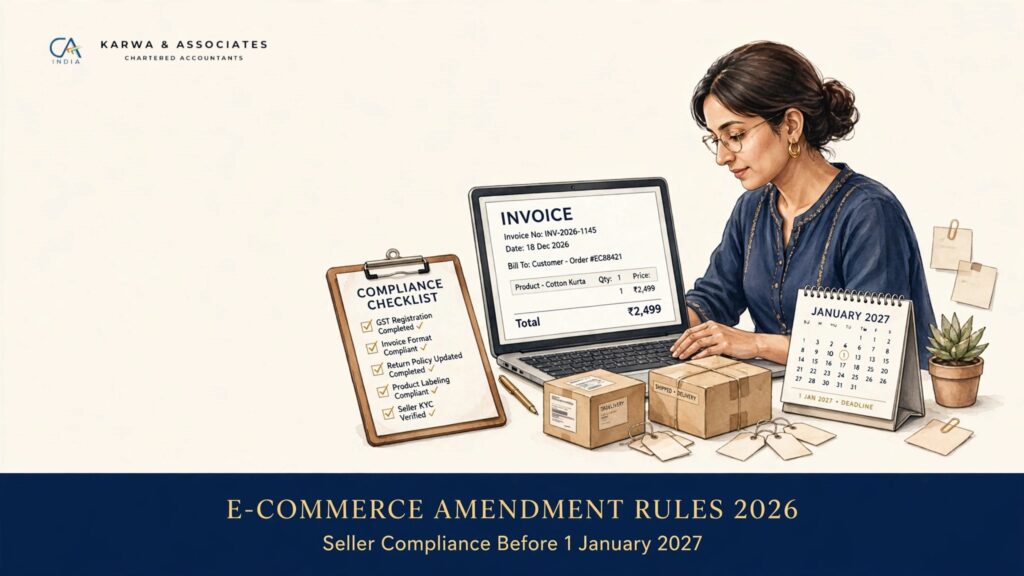
If you sell on a marketplace, run your own online store, or supply goods to a platform, a deadline is now fixed on your calendar. The Department of Consumer Affairs has notified the Consumer Protection (E-Commerce) (Amendment) Rules, 2026 through G.S.R. 789(E) dated 9 September 2026, amending the Consumer Protection (E-Commerce) Rules, 2020. The amended rules come into force on 1 January 2027.
This is not a cosmetic update. The amendment rewrites how prices and discounts are displayed, what your invoice must carry, how fast complaints must move, what a marketplace may charge and what it may do with consumer data. This guide explains each change in plain language, with the exact rule number, so your team can work through it as a checklist. For the shopper’s view of the same rules, read our companion explainer on what the new e-commerce rules 2026 mean for buyers.
Table of Contents
E-Commerce Amendment Rules 2026: The Prior Price Display
The most operationally demanding change is Rule 4(13). Where an e-commerce entity or a seller announces a price reduction, the prior price must be indicated along with the reduced price. The explanation to the rule defines prior price as the lowest price of the good or service thirty days prior to the announcement of the price reduction.
The practical consequence arrives a month early. A sale announced on 15 January 2027 will be judged against your prices from mid-December 2026. If your systems do not preserve a clean 30-day price history for every SKU, you cannot display a compliant prior price in January. Sellers should therefore start retaining daily price records now, in December itself, and brief whoever runs sale pricing that a pre-sale price hike no longer creates a discount, it creates a disclosure problem.
Worked example: a kurti sells at Rs 1,499 through December. On 10 January the seller raises it to Rs 2,999 and on 12 January announces a sale at Rs 1,499 as 50 percent off. Under Rule 4(13), the prior price shown must be Rs 1,499, the lowest price in the preceding 30 days. The claimed 50 percent saving collapses on the face of the listing.
E-Commerce Amendment Rules 2026: Seller Name on Every Invoice
Rule 4(14) requires every e-commerce entity to display, clearly and prominently in its invoice, the name of the seller in the same font size as that of the e-commerce entity’s name. Marketplaces will pass this obligation straight through to sellers in their seller agreements, and invoice templates, thermal print formats and PDF generators all need updating and testing before the deadline.
Alongside this, Rule 5(3)(a) requires marketplaces to show your business name, registration status, geographic address, customer care number and ratings at the pre-purchase stage, and to share your full details with a buyer who asks in writing after a purchase for dispute resolution. Rule 6(5)(j) requires you, as a seller, to provide the marketplace any identification number issued by the Central Government, including your GSTIN or your MSME (Udyam) registration number. If your GSTIN, Udyam registration, address or bank details on any marketplace are stale, correct them now: from January, that data is what the buyer sees.
E-Commerce Amendment Rules 2026: Sponsored Listings and Search Ranking
Three provisions govern how products surface in search. Rule 4(12) requires sponsored listings to be distinctly identified with clear and prominent disclosures. Rule 4(11)(c) prohibits misleading users by manipulating search results or search indexes having regard to the user’s search query. Rule 5(3)(f) requires every marketplace to publish an explanation of the main parameters that determine ranking, in descending order of significance, in plain and intelligible language.
For sellers, the working points are simple. Paid placements you buy must be labelled as sponsored; that is the platform’s duty, but expect revised advertising terms. Ranking will become more explainable, which makes genuine relevance signals (accurate titles, complete attributes, correct categorisation) worth more than gaming tricks that the manipulation ban now covers expressly.
E-Commerce Amendment Rules 2026: Grievance Timelines and the Complaint Copy
Rule 4(5) tightens the grievance machinery. The grievance officer must acknowledge a consumer complaint within forty-eight hours, provide the complainant with a copy of the complaint as recorded by the grievance officer, and redress the complaint within one month of receipt. Rule 4(7) also requires every e-commerce entity to become a partner in the convergence process of the National Consumer Helpline.
If you run your own store, your support workflow needs three upgrades: an acknowledgement that fires within 48 hours on every channel, a system that can hand the customer a copy of the complaint as recorded (a ticket export or a complaint PDF), and an escalation clock that closes the matter inside one month. Marketplace sellers should expect the same timelines to be enforced through seller performance metrics.
E-Commerce Amendment Rules 2026: Bundled Fees and Consumer Data
Rule 5(7) bars a marketplace from collecting bundled fees from users for services unrelated to the e-commerce platform, with an exception for loyalty or membership programmes and benefits under them. If your pricing model bundles platform services with unrelated add-ons, restructure it before January.
Rule 5(6) restricts what a marketplace may do with consumer information: it cannot be used for the sale of goods by any seller bearing a brand or name common with the marketplace, nor to promote or advertise a seller as associated with the marketplace, unless the marketplace has the express and affirmative consent of the consumers concerned. Private label teams and platform marketing teams carry this duty, and sellers in such programmes should expect fresh consent and data-use terms.
E-Commerce Amendment Rules 2026: Dark Patterns Self-Audit and Certificate
Rule 4(15) requires every e-commerce entity to comply with the Guidelines for Prevention and Regulation of Dark Patterns, 2023, to conduct a yearly self-audit to ensure the platform is free from dark patterns, and to display a certificate to this effect prominently. False urgency, basket sneaking, confirm shaming, subscription traps and drip pricing are the patterns named in those guidelines. Build the self-audit into your annual compliance calendar alongside your other certifications, and keep the audit working papers: the certificate must be displayed, and the Central Consumer Protection Authority has been actively enforcing against dark patterns through 2026.
Your Compliance Checklist Before 1 January 2027
| Rule | What changes | Who must act |
|---|---|---|
| Rule 4(13) | Prior price (lowest price of the last 30 days) shown with every reduced price | Platforms and sellers |
| Rule 4(14) | Seller name on the invoice in the same font size as the platform name | Platforms, passed to sellers |
| Rule 4(12) | Sponsored listings identified with clear and prominent disclosures | Platforms |
| Rule 4(11)(c) | No manipulation of search results or indexes against the user’s query | Platforms |
| Rule 5(3)(f) | Main ranking parameters published in plain language | Marketplaces |
| Rule 4(5) | Complaint acknowledged in 48 hours, copy of complaint to the customer, redress in one month | Every e-commerce entity |
| Rule 4(7) | Partnership in the National Consumer Helpline convergence process | Every e-commerce entity |
| Rule 5(7) | No bundled fees for services unrelated to the platform (loyalty programmes excepted) | Marketplaces |
| Rule 5(6) | Consumer information not to be used for house brands or seller promotion without express consent | Marketplaces |
| Rule 4(15) | Dark Patterns Guidelines compliance, yearly self-audit, certificate displayed | Every e-commerce entity |
| Rule 5(3)(a), Rule 6 | Seller business details displayed; GSTIN or Udyam number given to the marketplace | Sellers |
What Happens If You Miss the Deadline
The amendment creates no separate penalty of its own. Under Rule 8 of the principal rules, a contravention attracts the provisions of the Consumer Protection Act, 2019, which include the Central Consumer Protection Authority’s powers on unfair trade practices and misleading advertisements, with penalties that run into lakhs for a first contravention and rise sharply for repeat offences, alongside consumer commission proceedings by individual buyers who now hold better records, including a copy of their own complaint. The Department’s own numbers show why enforcement attention will stay high: of the 17,71,622 grievances received by the National Consumer Helpline in 2025, about 29 percent, 5,11,196 grievances, related to e-commerce.
How Karwa & Associates Can Help
Our team works with online sellers, D2C brands and marketplace suppliers on exactly this layer of compliance: GSTIN and Udyam hygiene across marketplaces, invoice and document reviews, consumer law compliance calendars and pre-deadline readiness checks. If you want a readiness review of your listings, invoices and grievance process against the table above, write to anshul@karwaandassociates.com or call 0141-2603671-72. Fees are quoted in rupees after the scope is fixed, following a short review of your current setup.
Karwa & Associates is based in Jaipur and serves clients across India and globally.
Frequently Asked Questions
Do the E-Commerce Amendment Rules 2026 apply to a seller who only sells on marketplaces like Amazon or Flipkart?
Yes, in substance. Several duties sit on the marketplace, but the prior price rule speaks of the entity or the seller announcing a price reduction, marketplaces will flow the invoice and disclosure duties down through seller agreements, and your seller information, GSTIN or Udyam number and product details are expressly covered.
From which date must price history be maintained for the prior price rule?
The rules take effect on 1 January 2027, and any price reduction announced on or after that date looks back 30 days. A reduction announced in early January 2027 is measured against December 2026 prices, so price records should be preserved from December 2026 at the latest, and preferably starting now.
Is a genuine sale or clearance discount still allowed?
Yes. The rules do not cap discounts. They require the prior price, the lowest price of the preceding 30 days, to be indicated with the reduced price, so the comparison a buyer sees is honest.
What is the penalty for not following the amended rules?
There is no separate penalty inside the amendment. A contravention of the e-commerce rules attracts the provisions of the Consumer Protection Act, 2019, including CCPA action for unfair trade practices and misleading advertisements, apart from individual consumer complaints.
Found this useful? Add Karwa and Associates as a preferred source on Google to see our latest tax and compliance updates more often: