
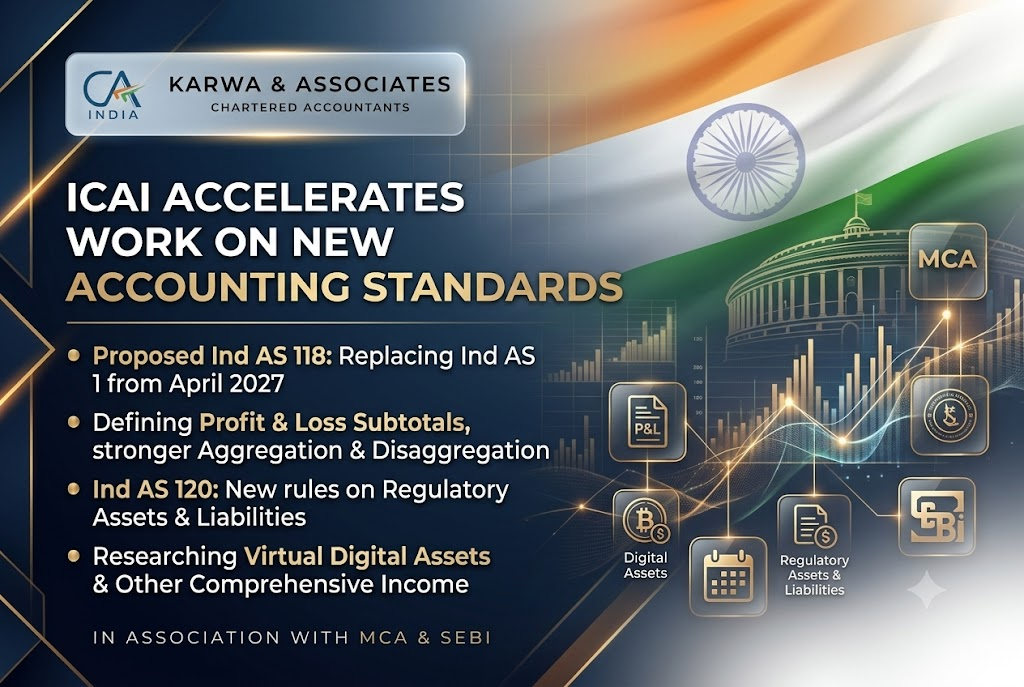
The Institute of Chartered Accountants of India (ICAI) is accelerating work on the proposed new standard on presentation and disclosure in financial statements, which will replace Ind AS 1. With a proposed effective date for annual reporting periods beginning on or after 1 April 2027, the new standard promises the most significant overhaul of the statement of profit and loss in over two decades. This post explains what it changes, what it means for Schedule III and SEBI reporting, and what your company should start doing now.
Table of Contents
What is Ind AS 118?
On 6 January 2025, ICAI’s Accounting Standards Board issued the exposure draft of the new standard, converging with IFRS 18 for presentation and disclosure in financial statements. It carries forward the requirements of Ind AS 1 but reorganises and expands them significantly.
The overall objective remains familiar: provide information that faithfully represents an entity’s assets, liabilities, equity, income and expenses (other than transactions with owners acting in their capacity as owners), and help users assess the entity’s prospects for future net cash inflows and management’s stewardship of the entity’s economic resources. What is new is structure and rigour: defined subtotals in the statement of profit and loss, disciplined disclosure of management-defined performance measures (MPMs), and a coherent framework for aggregation and disaggregation. It will replace Ind AS 1 when it becomes effective.
Ind AS 1 vs Ind AS 118: what is changing
| Area | Ind AS 1 (current) | Ind AS 118 (proposed) |
|---|---|---|
| Profit and loss structure | No mandatory subtotals beyond profit or loss | Two defined subtotals: operating profit, and profit before financing and income tax |
| Expense analysis | Nature-wise classification required | Nature, function, or mixed presentation, chosen using guiding factors |
| Non-GAAP measures | No audited disclosure required | Management-defined performance measures disclosed in a single audited note with reconciliation |
| Grouping of information | Limited guidance | Structured aggregation and disaggregation principles, discipline around “other” labels |
| Cash flow statement | Flexibility in the starting point | Operating profit as the consistent starting point under the indirect method |
The three big changes under Ind AS 118
1. Defined profit and loss subtotals
Every company will classify income and expenses into five categories: operating, investing, financing, income taxes, and discontinued operations. From this structure flow two mandatory subtotals: operating profit or loss, and profit or loss before financing and income taxes. Operating becomes the default category, so anything that does not fit elsewhere lands there. The bottom-line profit figure does not change, but comparability improves sharply because every company will now compute operating profit the same way.
2. Management-defined performance measures (MPMs)
This is the change boards and CFOs will feel most. If a company uses a subtotal such as adjusted EBITDA or underlying operating profit in investor presentations, earnings calls or press releases to communicate management’s view of performance, that measure becomes an MPM. It must then be disclosed inside the audited financial statements in a single note that reconciles the MPM to the most comparable Ind AS subtotal, explains why management considers it useful, and discloses the tax effect of the reconciling items. In short, non-GAAP measures move from glossy presentations into audited territory.
3. Stronger aggregation and disaggregation
The new standard lays down principles for deciding whether information belongs on the face of the statements or in the notes, and how finely it should be broken down. Companies may present operating expenses by nature, by function, or using a mixed presentation, applying the factors in the standard to pick the most useful structured summary. Those presenting by function will additionally disclose specified expenses by nature in the notes.
What Ind AS 118 means for Indian companies
- Schedule III revamp. Schedule III to the Companies Act, 2013 prescribes India’s presentation formats for financial statements. ICAI has placed its revision for Ind AS 118 in its official work programme and is working with the MCA on the changes (as reported here). Note carefully: a revised Schedule III has not been notified yet; this is implementation groundwork, not a done deal.
- SEBI reporting formats. Listed companies should expect consequential changes to SEBI’s disclosure formats for financial results once the standard is notified.
- Systems and chart of accounts. The five-category classification will need a one-time mapping of the chart of accounts and reporting systems, and the starting point for the indirect cash flow statement changes to operating profit.
- Comparatives. Application will be retrospective, so prior-year comparatives will need restatement, subject to transitional relief.
- Consequential amendments. Expect knock-on changes to Ind AS 7, Ind AS 33, Ind AS 34 and others, as happened globally with IFRS 18 (detailed technical overview).
Beyond Ind AS 118: Ind AS 120 and emerging issues
ICAI’s agenda does not stop at presentation. The institute is developing Ind AS 120 on regulatory assets and regulatory liabilities, and its research pipeline covers emerging areas including accounting for virtual digital assets and the future of other
comprehensive income. Companies in regulated sectors, and those holding crypto assets, should watch this space closely.
Ind AS 118 transition timeline: key dates
The new standard has been years in the making, and the runway to April 2027 is shorter than it looks. Here are the milestones so far, and the ones still to watch.
- April 2024: the IASB issues IFRS 18, Presentation and Disclosure in Financial Statements, replacing IAS 1. The global countdown begins.
- 6 January 2025: ICAI’s Accounting Standards Board issues the exposure draft of the new Indian standard, converged with IFRS 18.
- 6 April 2025: last date for public comments on the exposure draft.
- 1 January 2027: IFRS 18 becomes effective globally, for annual reporting periods beginning on or after this date.
- 1 April 2027: the proposed effective date in India, for annual periods beginning on or after this date. Still subject to notification by the MCA.
- Still to watch: the MCA’s notification of the final standard, the revised Schedule III, and SEBI’s updated reporting formats.
Who needs to prepare: every company that prepares financial statements under Ind AS, which includes listed companies and large unlisted companies. If your financials carry an Ind AS audit opinion, the new presentation requirements will reshape your statement of profit and loss, so the time to start is now.
What companies should do now
- Assess the gap: map your current statement of profit and loss against the five categories and the two mandatory subtotals.
- Inventory your MPMs: list every adjusted measure used in investor communications. Each one will need an audited reconciliation.
- Review expense presentation: decide between nature, function or mixed presentation, and prepare for by-nature note disclosures if you report by function.
- Engage systems teams early: chart of accounts and reporting changes take time to implement and test.
- Track Schedule III: follow ICAI and MCA announcements on the format revamp rather than assuming the current formats survive.
- Train finance teams: concepts such as MPMs are new to Indian practice and will need internal guidance.
Frequently asked questions
What is Ind AS 118?
Ind AS 118, Presentation and Disclosure in Financial Statements, is ICAI’s proposed accounting standard converged with IFRS 18. It is set to replace Ind AS 1.
When does Ind AS 118 become effective?
The proposed effective date is for annual reporting periods beginning on or after 1 April 2027. It is still proposed and must be notified by the MCA.
Does Ind AS 118 change net profit?
No. Measurement of profit is unchanged. The standard changes presentation, introduces defined subtotals, and adds disclosures.
What are management-defined performance measures?
Subtotals such as adjusted EBITDA that a company uses in public communications to convey management’s view of performance. Under Ind AS 118 they must be disclosed and reconciled within the audited financial statements.
Will Schedule III of the Companies Act change?
ICAI has the Schedule III revision in its work programme and is working with the MCA, but a revised Schedule III has not been notified yet.
The new standard will redraw the face of Indian financial statements. The companies that start early, mapping their charts of accounts, inventorying their performance measures and preparing their teams, will find the transition smooth. Those that wait for the notification may find April 2027 arriving uncomfortably fast. At Karwa & Associates, we help companies prepare for regulatory change, from advisory to audit readiness. If your company reports under Ind AS and wants a gap assessment or implementation roadmap, contact our team.