
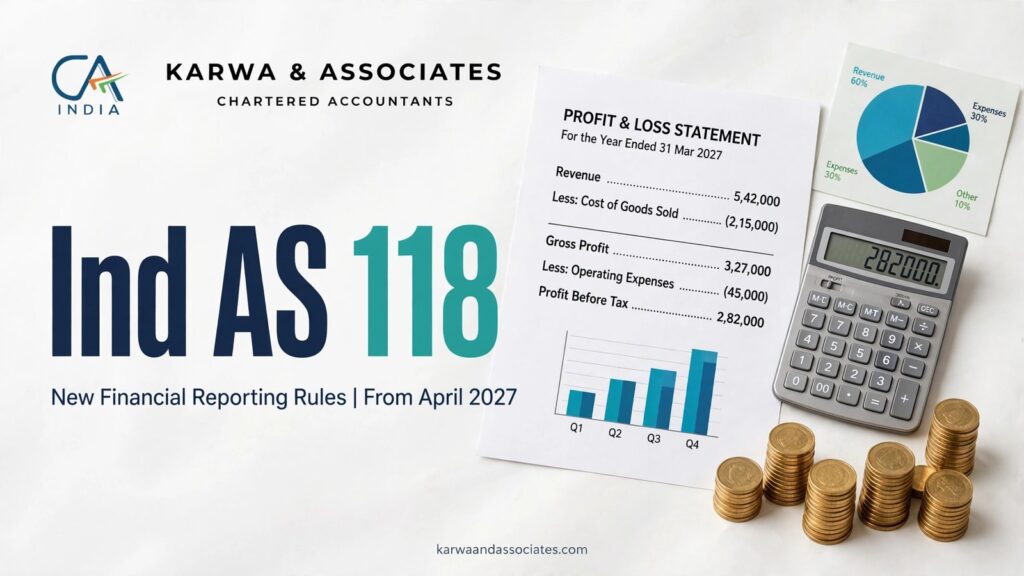
Audit committees and management teams at India’s largest companies have started preparing for Ind AS 118, the proposed accounting standard that will change how companies present profit, classify income and expenses, and explain performance to investors. India has proposed implementation from April 1, 2027, for annual reporting periods beginning on or after that date, subject to notification by the Ministry of Corporate Affairs (MCA). IFRS 18, the international standard Ind AS 118 is converged with, takes effect internationally from January 1, 2027.
For companies, the change goes beyond a new format. It affects how operating profit is defined, how expenses are grouped, which performance measures must be reconciled inside the audited accounts, and what their ERP systems and internal controls must capture. This post explains what is changing, what is still awaited, and what companies should do now.
Key takeaways: Ind AS 118 will replace Ind AS 1, bringing defined categories and subtotals, including operating profit, to the profit and loss statement. Companies must also disclose management-defined performance measures with reconciliations. Implementation is proposed from April 1, 2027, subject to MCA notification.
Source: This post draws on a report in The Economic Times (ETCFO), Major Overhaul in Indian Financial Reporting, by Vinod Mahanta, published on October 26, 2026, and on the MCA/NFRA framework for Ind AS 118. Where a development is not yet formally confirmed, this post says so.
What Ind AS 118 is
Ind AS 118, Presentation and Disclosure in Financial Statements, will replace Ind AS 1. It is converged with IFRS 18, issued by the International Accounting Standards Board in April 2024. Its objective is to improve comparability and transparency: investors should be able to compare financial performance across companies on a consistent basis, instead of working around company-specific definitions of profit.
It does not change recognition and measurement. What changes is presentation and disclosure: how income and expenses are categorised, which subtotals must be shown, and what must be disclosed about performance measures that management uses outside the financial statements.
Defined categories and standardised subtotals
Under Ind AS 118, income and expenses will fall into defined categories: operating, investing and financing. The statement of profit and loss will carry specified subtotals, including operating profit and profit before financing and income taxes. Companies must reconcile these subtotals with the figures they currently report, which is where analysts may need to adjust their models.
Expenses by nature, by function, or both
Companies may present operating expenses by nature, by function, or using a combination of both, as permitted by the applicable requirements. Today, most Indian companies report expenses by nature. A shift to functional presentation would require costs such as employee benefits and depreciation, currently reported by nature, to be allocated across functions such as cost of sales, distribution, research and development, sales and marketing, and general administration. Companies that present by function typically show a “gross margin” subtotal.
For companies whose cost structures do not support functional allocations easily, this is one of the harder parts of the transition: finance teams will need consistent allocation principles and supporting evidence, worked out with human resources and other business functions.
Management-defined performance measures must come inside the audit
For the first time, certain performance measures that management uses in public communications outside the financial statements will have to be disclosed within the audited financial statements, in a single dedicated note. These management-defined performance measures (MPMs) include familiar figures such as adjusted operating profit and adjusted EBITDA.
For each MPM, companies must describe what aspect of performance it communicates and why it is useful, reconcile it line by line to the most directly comparable Ind AS subtotal, and disclose the tax effect of each reconciling item and its effect on non-controlling interests. Definitions must be applied consistently, and any change must be explained with restated comparatives. The practical consequence: measures that previously lived in investor presentations and press releases will now fall within statutory audit scope.
ERP systems and internal controls will need work
The changes may require modifications to accounting systems, chart of accounts, reporting processes and data collection. Internal controls will need to ensure that classifications, reconciliations and disclosures are accurate and supported by appropriate evidence.
The difficulty, for now, is timing: with final rules and reporting formats still awaited, companies are reluctant to commit to systems changes before the requirements are settled. That hesitation is itself a risk, because restating comparatives and rebuilding allocation logic cannot be done at the last minute.
Contracts and incentive plans may need a second look
Where contractual terms, management remuneration or performance-linked incentives depend on specific profit measures, companies may need to assess whether revised presentation affects existing calculations. Incentive structures linked to self-defined subtotals such as operating profit are the obvious example: if the definition of the subtotal changes, the arrangement may need amendment and discussion with the relevant counterparties.
Why preparation has started now, and why it varies
Levels of preparedness vary. Some companies have begun transition planning; others are waiting for final rules. As Samir Shah, audit leader at Deloitte Haskins & Sells, put it, “The transition to IFRS 18 is increasingly becoming a boardroom issue.” Audit committee chairs point to the same tension: the objective is better comparability, but in a difficult business environment the transition will put considerable pressure on companies and audit committees. The lack of final rules and reporting formats is complicating preparations.
Two further developments are worth noting, both unconfirmed. Industry sources cited in the press report say the Indian standard has been finalised and notification is expected soon, while a possible one-year deferral is also under consideration. Neither has been formally confirmed. Separately, the National Financial Reporting Authority (NFRA) has recommended Ind AS 118 to the Central Government for notification, with an effective date for annual reporting periods beginning on or after April 1, 2027, and early adoption from January 1, 2027 for companies following a calendar year. Changes to Schedule III of the Companies Act, which governs financial statement formats, are also expected.
What companies should do now
The intervening period is best used for no-regret preparatory work:
- Map existing profit and loss lines to the proposed operating, investing and financing categories, and identify where current subtotals will change.
- Identify every management-defined performance measure used in public communications, and start building the reconciliation to the nearest Ind AS subtotal.
- Assess data and system requirements: what the chart of accounts, ERP and reporting tools must capture that they do not capture today.
- Review internal controls over classification, allocation and disclosure, and agree allocation principles for expenses that will move from nature to function.
- Review contracts, loan covenants and incentive plans that reference profit measures, and flag those that may need amendment.
Early preparation puts a company in a stronger position to implement the final requirements efficiently once the regulatory framework is settled.
What this means for finance and audit professionals
The transition is not merely about changing the format of financial statements. It requires a broader review of accounting policies, reporting systems, expense allocation practices and internal control frameworks. Companies will need to focus not only on how much profit they report, but also on how that performance is presented and explained to stakeholders. For auditors and finance professionals, understanding these changes early is important to identifying implementation gaps and ensuring a smoother transition. The key takeaway: better comparability requires consistent reporting, reliable data and stronger supporting processes.
Key dates
| Development | Date / status |
|---|---|
| IFRS 18 effective internationally | Annual reporting periods beginning on or after January 1, 2027 |
| Ind AS 118 proposed implementation in India | Annual reporting periods beginning on or after April 1, 2027, subject to MCA notification |
| NFRA recommendation to Central Government | Made (December 2025 meeting), notification awaited |
| Schedule III format changes | Expected, formats awaited |
| Possible one-year deferral | Reported as under consideration, not formally confirmed |
Frequently asked questions
When will Ind AS 118 apply in India?
Implementation is proposed from April 1, 2027, for annual reporting periods beginning on or after that date, subject to notification by the MCA. Until the notification is issued, the date remains proposed, not final.
Does Ind AS 118 change how much profit a company reports?
No. It is expected to affect presentation and disclosure, not recognition and measurement. What changes is how profit is categorised, subtotalled and explained.
What is a management-defined performance measure?
A subtotal of income and expenses that management uses in public communications outside the financial statements to communicate its view of an aspect of financial performance, and that is not already a subtotal specified by Ind AS. Adjusted EBITDA is a common example. Such measures must now be disclosed in a single audited note with a reconciliation to the nearest Ind AS subtotal.
Will financial statement formats change?
Yes, changes to Schedule III of the Companies Act are expected, since it governs financial statement formats. The final formats are awaited.
Related reading
Read our detailed guide: Ind AS 118.
Note: India’s implementation date of April 1, 2027 is proposed and subject to MCA notification. We will update this post when the notification is issued.

CA Anshul Karwa is a Chartered Accountant (DISA-qualified) and Partner at Karwa & Associates, Chartered Accountants, Jaipur. A non-commerce student who cleared CA in the first attempt, he worked with Big 4 firms and MNCs before joining the firm. He also builds digital apps, websites and tools for CAs, founders and other professionals, and writes books on investing.