
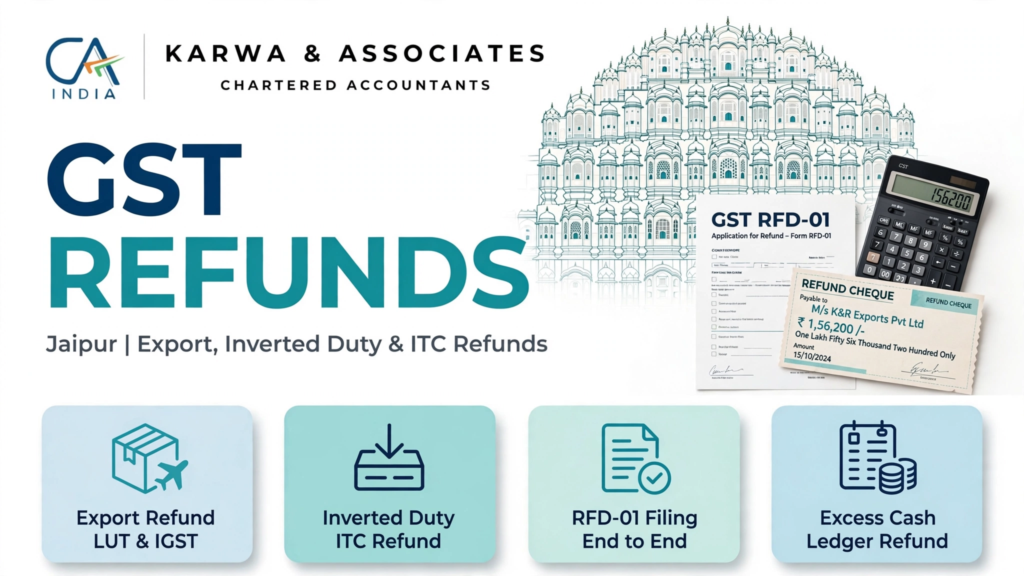
GST Refund: The Complete RFD-01 Filing Guide (Export, Inverted Duty & LUT)
A GST refund is the government returning tax money that is rightfully yours: input tax credit you could not use, tax you paid in excess, or IGST paid on exports. The application goes in Form RFD-01 on the GST portal, and the law sets a two-year time limit for most categories. This guide covers the refund types, the filing process, the documents you need, and the mistakes that get claims rejected.
Who can claim a GST refund
- Exporters of goods: refund of IGST paid on exports (automatic through the Customs/ICEGATE route via the shipping bill) or refund of accumulated ITC when exporting under LUT (through RFD-01).
- Exporters of services: refund of accumulated ITC on zero-rated service exports through RFD-01, with BRC or FIRC as proof that export proceeds were received.
- Businesses with inverted duty structure: where the GST rate on inputs is higher than on outward supplies, so ITC accumulates unused.
- Taxpayers with excess cash ledger balance: overpaid tax sitting in the electronic cash ledger, claimable any time with no time limit.
- Suppliers to SEZ units and developers: zero-rated supplies with ITC refund.
- Deemed exporters, wrong-head payments, and appeal orders: each with its own RFD-01 route and relevant date.
Form RFD-01: the filing process step by step
- Log in to the GST portal and open Services, then Refunds, then Application for Refund.
- Select the refund category: export, inverted duty structure, excess cash ledger, SEZ, deemed export, or order-based.
- Choose the tax period. The portal auto-populates ITC and turnover from your filed GSTR-3B and GSTR-1, so verify these against your books before proceeding.
- Fill the statements the category requires: Statement 3A/3B for LUT exports, Statement 1A for inverted duty, and so on.
- Attach supporting documents: invoices, shipping bills, BRC/FIRC, LUT copy, and a CA certificate if the claim exceeds Rs 2 lakh.
- File with DSC or EVC. The system generates an ARN, then the officer issues the acknowledgement in Form RFD-02.
- Track the claim: 90% provisional refund in Form RFD-04 within 7 days of acknowledgement for export and inverted duty claims, final order in Form RFD-06 within 60 days of a complete application.
Export refund: with IGST vs under LUT
Two routes exist, and mixing them up is a common error. If you pay IGST on export, the shipping bill itself is the refund application and it travels the Customs route, not RFD-01 (for services exported with IGST payment, RFD-01 still applies). If you export under LUT or bond, no IGST is charged; instead you claim refund of the accumulated input tax credit through RFD-01. The refund formula apportions your net ITC to the zero-rated turnover: (zero-rated turnover multiplied by net ITC) divided by adjusted total turnover.
Inverted duty structure refund: the formula that surprises people
Under Rule 89(5), the maximum refund equals (turnover of inverted-rated supplies multiplied by net ITC, divided by adjusted total turnover) minus the tax payable on those inverted-rated supplies. That last deduction is the part most businesses miss: the formula does not return all your accumulated ITC. Only input goods count historically; input services were excluded, though the 2026 changes are widening this. Certain categories like petroleum and automobiles are restricted entirely. Get the computation checked before filing, because an inflated claim invites scrutiny while the correct figure sails through.
LUT: the document exporters forget
The Letter of Undertaking is filed on the portal before the financial year and lets you make zero-rated supplies without paying IGST. An expired or missing LUT at the time of export breaks the refund chain. File it in advance, keep the acknowledgement, and renew it every year without fail.
Why refund claims get rejected
- GSTR-2B mismatch: ITC claimed in GSTR-3B does not match supplier-reported data. Reconcile monthly.
- Wrong turnover figures: the portal auto-fills from GSTR-1, but amendments and credit notes change the picture. Verify.
- Missing BRC/FIRC: service exporters must prove foreign exchange realization. No certificate, no refund.
- Time-barred claims: the two-year clock under Section 54 runs from the relevant date, which differs by category. Track every deadline.
- Restricted categories: claiming inverted duty refund on notified restricted goods is dead on arrival.
What the 2026 reforms change
Two developments matter. The Budget 2026 changes extended the 90% provisional refund to inverted duty claims and removed the minimum threshold for export refunds, so even small claims get processed. The 57th GST Council (October 2026) has recommended going further: system-driven refunds, automatic sanction of excess cash ledger balances, a 10-day acknowledgement window (with deemed acceptance if the officer does not act), and no scanned document uploads for export and inverted duty claims. These proposals await notification; until then the current 15-day acknowledgement and officer-driven process apply. Note that the Finance Ministry has indicated the automatic route will exclude cases where an earlier refund order is under appeal, notified goods such as areca nut, pan masala, tobacco and essential oils, and businesses without Aadhaar authentication.
Interest on delayed refunds
If the department does not sanction your refund within 60 days of receiving the complete application, interest at 6% per annum is payable from the day after the 60-day period until the refund is credited. Track your ARN dates; the interest is your legal entitlement, not a favour.
ITC stuck, or export refunds pending? Karwa & Associates files RFD-01 refund claims, LUTs, and deficiency replies for businesses across Rajasthan. Call 0141-2603671-72 or reach us through the contact page.
About the Author
Written and reviewed by CA Anshul Karwa, Chartered Accountant (DISA-qualified) associated with Karwa & Associates, Chartered Accountants, Jaipur.