
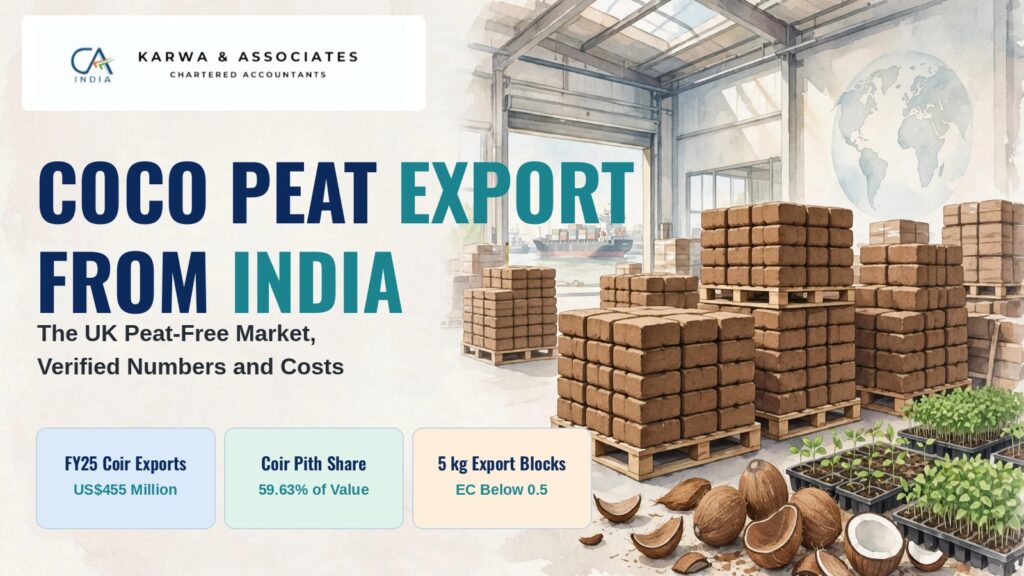
Coco peat, also called coir pith, is the soft, spongy material left after coconut fibre is separated from the husk. Washed, dried and pressed into 5 kg blocks, it has become one of the most traded growing media in the world, because it holds water, drains well and replaces peat in greenhouses and nurseries. India is the world’s largest exporter of it, and the United Kingdom and Europe are among its biggest buyers.
This post explains what an Indian unit needs to enter that export market, and how Coco Peat Export from India works in practice: the real state of the UK peat ban, the verified export numbers, the quality standards buyers test, the setup cost, the registrations and the risks. One correction comes first, because it changes how the opportunity should be read. The UK peat ban has been announced, but it has not yet become law.
The demand is real, and it is growing, but it is being driven by policy direction and by the trade moving voluntarily, not by a ban already in force. Any plan built on the assumption that a ban is already in force would be built on a wrong date.
Table of Contents
Coco Peat Export from India: Why the Opportunity Exists
Peat has been the default growing medium in UK horticulture for decades. Peatlands store carbon, so governments have wanted to phase peat out of horticulture for years. In August 2022 the UK Department for Environment, Food and Rural Affairs (Defra) announced a ban on retail sales of peat compost in England from the end of 2024. In March 2023 it announced that professional growers would follow, with the use of peat in professional horticulture to end in December 2026 and time-limited exemptions for uses such as plug plants and mushrooms running to 2030.
That timetable did not survive the change of government in 2024. The retail ban did not come into effect at the end of 2024, and the legislation is now stalled. The Royal Horticultural Society (RHS) states this plainly: there is no government legislation on a peat ban, and no official definition of peat-free. In February 2026 ministers from the UK nations agreed that legislation to ban peat in horticulture would be best taken forward jointly, and they asked Defra for an update on timelines. As of November 2026, no ban is in force in any part of the United Kingdom.
What has happened anyway is a voluntary shift. The RHS will sell only plants grown peat-free, or grown in peat already in the production cycle before the end of 2025, from January 2026. Major retailers have made the same commitment. Professional peat use had already fallen below one million cubic metres in 2022, and below half of all growing media used by the professional sector, according to the Horticultural Trades Association and the Growing Media Association. Growers are trialling peat-free mixes now, because they cannot be sure when the law will arrive, and because their customers are already asking for peat-free plants.
That is the honest opportunity for an Indian exporter. Coco peat is the main peat-free substitute with proven scale, and the buyers are already buying it. The risk is that the law may arrive later than announced, or in a different form, so the business case must work on current demand, not on a future ban date.
Coco Peat Export from India: The Verified Export Numbers
India is the world’s largest producer and exporter of coir and coir products, accounting for about two-thirds of global production, according to the Ministry of Micro, Small and Medium Enterprises (MSME). The figures below come from the Coir Board of India and the Ministry of Commerce, as published by the India Brand Equity Foundation (IBEF).
| Indicator | Figure | Source |
|---|---|---|
| India coir and coir products exports, FY 2024-25 | US$455 million | IBEF, source Coir Board of India |
| Coir pith share of FY 2024-25 export value | 59.63% | IBEF, source Coir Board of India |
| Tufted mats share of FY 2024-25 export value | 16.73% | IBEF, source Coir Board of India |
| Coir fibre share of FY 2024-25 export value | 12.06% | IBEF, source Coir Board of India |
| India coir exports, Apr-Jul 2025 (FY 2025-26) | US$209 million, up 62.86% year on year | IBEF |
| India coir exports, FY 2025-26 | Rs 6,614.40 crore | Ministry of MSME, October 2026 |
| Coir pith exported, calendar 2025 | 9.54 lakh tonnes, US$486.9 million | International Coconut Community, March 2026 review |
The top destinations for Indian coir exports are the United States, China, the Netherlands, Spain and the United Kingdom. The Netherlands matters beyond its own greenhouses: it is Europe’s distribution hub for growing media, so a shipment landing in Rotterdam can reach growers across the continent. The United States is the largest single importer of coir under HS 5305, and the UK is a steady buyer even before any ban takes effect.
The classification to use is HS code 53050040 for coir pith, and it is the code most buyers and brokers expect to see on a Coco Peat Export from India shipping bill. Some shipments are classified under 1404.90.99 depending on the product form and the destination country’s practice, so the code on the shipping bill should match the buyer’s requirement and the customs practice at the port of loading. Getting this wrong can delay clearance, so confirm it with the customs broker before the first shipment.
Coco Peat Export from India: What Buyers Actually Test
Export buyers do not buy on price alone. A greenhouse grower who switches a crop to a new medium risks the whole crop, so the first order is small and the testing is strict. The parameters below are the ones buyers routinely specify. A unit that cannot test and report these numbers will struggle to get past the first sample order.
| Parameter | What buyers expect | Why it matters |
|---|---|---|
| Electrical conductivity (EC) | Below 0.5 mS/cm for low-EC grade | High salt damages seedlings and young plants |
| pH | About 5.5 to 6.5 | Outside this range, nutrients become unavailable to roots |
| Moisture content | 10 to 15% | Higher moisture adds freight cost and risks mould |
| Expansion on rehydration | 6 to 9 times the compressed volume | Growers plan their mix ratios on this figure |
| Block weight and size | 5 kg blocks, about 30 x 30 x 15 cm | Standard size fits pallets, containers and handling equipment |
| Sieving | 6 mm sieved, fibre removed | Fibre and dust cause uneven water holding |
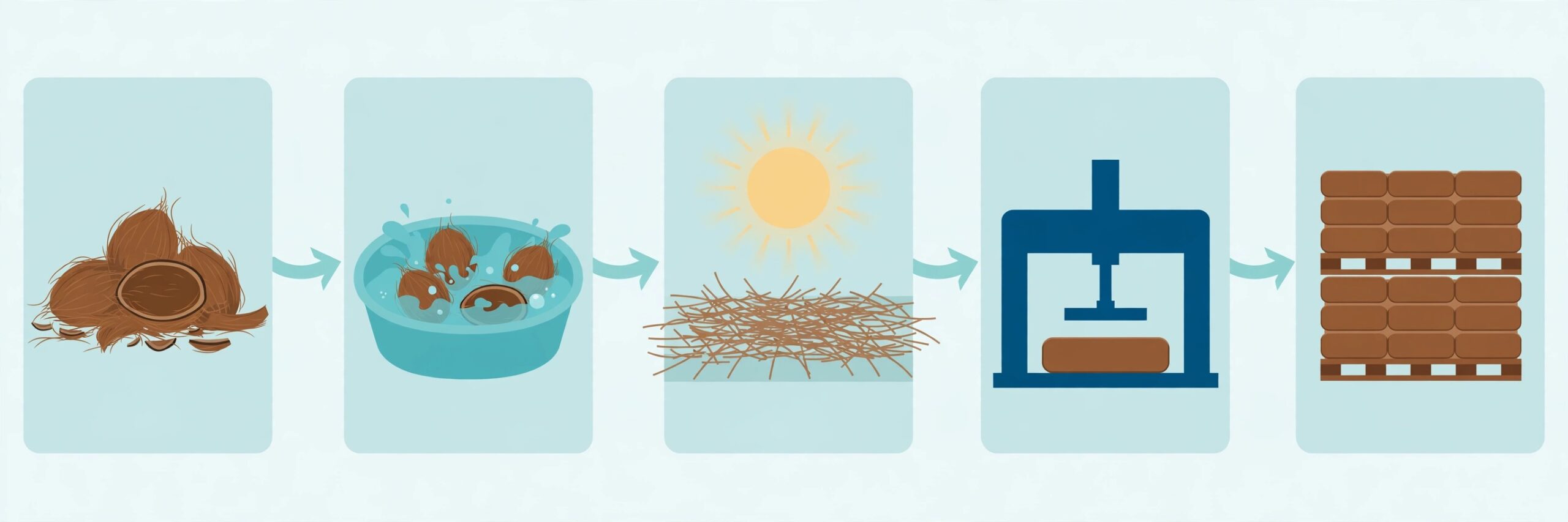
Washing is what separates export grade from domestic grade, and it is the step that decides whether a Coco Peat Export from India consignment passes the buyer’s first test. Raw coir pith is high in soluble salts, so export-grade pith is soaked and agitated in fresh water to bring the EC down, then dried. Some buyers also ask for buffered pith, treated with calcium nitrate to stabilise the chemistry. A laboratory test report for EC and pH should accompany the sample, and every commercial shipment should carry a test certificate for the batch.
Coco Peat Export from India: Setup Cost Breakdown
A frequently quoted figure for setting up a coco peat export unit is Rs 50 to 75 lakh. That figure comes from a social media reel, and it has not been verified to the rupee. The table below breaks it into components using published machinery prices and project report data, so a reader can see what the money is for. All figures are estimates, and they vary with location, scale and whether land and shed are owned or leased.
| Component | Indicative range | Notes |
|---|---|---|
| Coco peat block press (hydraulic, 5 kg blocks) | Rs 1.5 to 4 lakh | 200 to 500 blocks a day, the main machine |
| Washer (rotary drum or tank system) | Rs 0.8 to 2 lakh | Needed for low-EC export grade |
| Dryer (hot air or rotary drum) | Rs 0.5 to 1.5 lakh | Drying is the most energy intensive stage |
| Defibering and sieving machine | Rs 0.4 to 1.2 lakh | Separates fibre from pith, sieves to 6 mm |
| Conveyors, trolleys, pumps, handling | Rs 1 to 2 lakh | Varies with layout |
| Total plant and machinery | Rs 5 to 10 lakh | Published project report range |
| Shed, civil works and electrical | Rs 10 to 20 lakh | Own shed; a leased shed costs far less upfront |
| Pre-operative costs (registrations, trials, samples) | Rs 2 to 5 lakh | Includes buyer samples and test reports |
| Working capital (raw material, wages, freight) | Rs 20 to 30 lakh | Two to three months of operations |
| Total project, mid-scale export-grade unit | Rs 50 to 75 lakh | Estimate range, not a verified figure |
Two points matter here for anyone planning Coco Peat Export from India. First, a small domestic unit can start far below this range, because the machinery alone is Rs 5 to 10 lakh and a shed can be leased. Second, the largest single cost is not machinery but working capital. Raw coir pith is 50 to 60 percent of annual operating cost, and export buyers often pay after shipment, so the unit must fund raw material, processing and freight for weeks before the first payment arrives. A unit that budgets only for machines and forgets working capital will stall after its first order.
Location matters too. The coir clusters are in Tamil Nadu (Pollachi, Coimbatore, Tuticorin), Kerala and Karnataka, close to coconut husk supply and to machine manufacturers. Setting up far from the husk belt adds freight on a bulky, low value raw material, and that freight eats the margin before the product reaches the port.
Coco Peat Export from India: Worked Unit Economics
The table below is an illustration, not a forecast. It uses published figures and states its assumptions, so a reader can replace them with real quotes. No return is promised, and no payback period is claimed.
| Item | Illustrative figure | Basis |
|---|---|---|
| Export realisation, washed 5 kg blocks | About US$825 per tonne | Bill-of-lading records, shipments to Peru, September 2024 |
| Blocks per tonne | 200 blocks of 5 kg | Standard 5 kg format |
| Realisation per block at the port | About Rs 363 per block | US$825 per tonne at Rs 88 per US dollar |
| Domestic ex-factory price, standard blocks | Rs 85 to 120 per block | Published project report data |
| Raw coir pith share of operating cost | 50 to 60% | Published cost models |
| Energy (drying fuel and electricity) | 12 to 18% of operating cost | Published cost models |
| Labour | 15 to 20% of operating cost | Published cost models |
The gap between the domestic price of Rs 85 to 120 per block and the export realisation of about Rs 363 per block is not profit. The export figure is for washed, low-EC, sieved blocks, and it must absorb washing, drying, testing, packing, palletising, inland freight to the port, port handling, documentation and the buyer’s quality rejections.
Published project data puts the gross margin on domestic blocks at 40 to 60 percent over raw material cost, but that is a range for domestic sales, not a forecast for export profit. The honest way to test the business is to get a firm quote for raw pith delivered to the unit, a firm freight quote to the port, and a firm price from a buyer for a trial container, and only then to work out whether the margin covers the fixed costs.
Coco Peat Export from India: Registrations and Documents Checklist
An export unit needs registrations before the first shipment. The order below is the practical sequence, and the fees are the published ones.
| Step | What to do | Notes |
|---|---|---|
| 1 | Register the business and get GST registration | Needed before the IEC and the LUT |
| 2 | Importer Exporter Code (IEC) from DGFT | Rs 500, applied online on dgft.gov.in; mandatory for all exports |
| 3 | Register as a coir exporter with the Coir Board | Under the Coir Industry (Registration and Licensing) Rules, 1958 |
| 4 | Registration-cum-Membership Certificate (RCMC) from the Coir Board | Rs 21,250 including 18% GST for export registration plus RCMC; valid five years |
| 5 | File a Letter of Undertaking (LUT) on the GST portal | Lets the unit export without paying IGST |
| 6 | AD code from the bank, registered through ICEGATE | Needed for customs clearance and for receiving export payment |
| 7 | Phytosanitary certificate where the destination requires it | Issued by Plant Quarantine after inspection; confirm with the buyer first |
| 8 | Certificate of Origin | Issued through the Coir Board or the usual channels, if the buyer asks for it |
Two updates to note. First, from 15 September 2026, export consignments up to Rs 3 lakh FOB are exempt from the RCMC requirement under Notification No. 36/2026-27. That helps small trial shipments, but the IEC is still mandatory, and the RCMC is still required to claim benefits under schemes such as EPCG, Advance Authorisation and DFIA.
Second, the phytosanitary requirement depends on the destination. The European Union requires a phytosanitary certificate for listed plants and plant products under Regulation (EU) 2019/2072, and India issues these through Plant Quarantine. Fumigation is required only if the destination or the buyer asks for it, so do not pay for fumigation before checking. Confirm the exact requirement with the buyer and the plant quarantine station before booking the shipment, because a rejected consignment at the destination port is the most expensive lesson in this trade.
Coco Peat Export from India: Buyer Markets and How to Find Them
The buyers are not garden centres. They are growing media manufacturers, large greenhouse operators, hydroponic farms and distributors who blend coco peat into peat-free mixes. The Netherlands is the main European hub, Germany and the UK are large direct buyers, and the United States, South Korea and China are the largest volume destinations for Indian shipments overall.
A new unit should not start by chasing the largest buyers. Large manufacturers want a full container a month, every month, with identical quality, and they will test three or four suppliers before committing. A realistic first step is a trial order of one container, often arranged through a merchant exporter or a buying agent who already supplies the market. Trade fairs for horticulture, the Coir Board’s buyer-seller meets, and the export promotion councils are the usual routes to first contact. Samples should go with a test report for EC and pH, a clear statement of the block size and weight, and the moisture content. A buyer who receives a sample without a test report will usually not reply.
Payment terms deserve the same care as quality in Coco Peat Export from India. A first order should be against an irrevocable letter of credit or advance payment, not open account. Export credit insurance through ECGC is worth considering once volumes grow, because a single unpaid container can wipe out a small unit’s working capital. For a comparable market-entry guide, see our India New Zealand FTA export guide.
Coco Peat Export from India: Risks and Honest Limits
This is a real opportunity, but it is not a guaranteed one, and the limits of Coco Peat Export from India should be stated plainly.
First, the UK ban is not yet law. If the legislation is delayed again, or if it arrives with wide exemptions, demand will grow more slowly than the headlines suggest. The business must work on the demand that exists today.
Second, prices move. Coconut prices rose sharply from September 2024, and raw pith prices follow the coconut cycle. A quote given in one month may not hold the next, so contracts should be short and raw material should be bought against confirmed orders, not stockpiled on speculation.
Third, quality rejection is the most common reason a new exporter loses a buyer. One container with EC above the agreed limit, or with moisture above 15 percent, can end the relationship. The cost of a laboratory test is small compared with the cost of a rejected container.
Fourth, freight matters more than it looks. Coco peat is bulky and light, and inland freight from a unit far from the port can erase the margin. Units in the Tamil Nadu and Kerala clusters have a structural advantage here.
Fifth, working capital is the silent risk. Export payments take weeks, and a unit that takes three orders at once without the cash to fund them will default on delivery. Growth should be funded, not assumed.
A Note for Rajasthan and Jaipur Readers
Rajasthan is not a coconut growing state, so a coco peat unit cannot be set up in Jaipur on local raw material. The husk belt is Tamil Nadu, Kerala and Karnataka, and that is where the processing units are.
For a Jaipur based reader, the realistic roles in this trade are merchant exporting, sourcing from a Tamil Nadu or Kerala processor and supplying a buyer, or investing in a unit in the husk belt with a local partner. The registrations in the checklist above apply in exactly the same way to a merchant exporter, and the Coir Board registration is available to merchant exporters as well as manufacturers. Karwa and Associates is based in Jaipur and serves clients across India and globally. Jaipur readers who also export gems can see our Rajasthan gems export subsidy guide.
Sources
- GOV.UK, Inter-Ministerial Group for Environment, Food and Rural Affairs communique, 5 February 2026: ministers agreed legislation to ban peat in horticulture would be best taken forward jointly, and sought a timeline update from Defra.
- Royal Horticultural Society, “RHS Retail peat-free from January 2026”, 5 June 2026: the announced retail ban did not come into effect at the end of 2024, and the legislation is now stalled.
- India Brand Equity Foundation, Coir Industry in India (source: Coir Board of India, Ministry of Commerce): FY 2024-25 exports US$455 million, coir pith 59.63% of export value, April to July 2025 US$209 million.
- Ministry of Micro, Small and Medium Enterprises, October 2026: FY 2025-26 coir exports Rs 6,614.40 crore.
- International Coconut Community, March 2026 review: calendar 2025 coir pith exports 9.54 lakh tonnes, US$486.9 million.
- Coir Board of India, guidelines for registration as an exporter of coir and coir products: Rs 21,250 including GST for export registration plus RCMC, valid five years.
- Finline project report data for coir based products: machinery Rs 5 to 10 lakh, block press Rs 1.5 to 4 lakh, washer Rs 0.8 to 2 lakh, dryer Rs 0.5 to 1.5 lakh.
- Expert Market Research and IMARC coco peat cost models: expansion 6 to 9 times, moisture 10 to 15%, EC below 0.5 mS/cm, raw material 50 to 60% of operating cost.
- Volza bill-of-lading records: washed 5 kg blocks to Peru, September 2024, about US$825 per tonne.
- Notification No. 36/2026-27, 15 September 2026: RCMC exemption for consignments up to Rs 3 lakh FOB.
About the Author
CA Anshul Karwa is a Chartered Accountant and Partner at Karwa and Associates, Jaipur. The firm advises exporters on registrations, GST, foreign trade policy benefits and the documentation for export transactions. This post is general information, not advice for a specific transaction, and the figures quoted are from the sources listed above. Verify the current position with the relevant authority before acting, because trade rules and timelines change.
Found this useful? Add Karwa and Associates as a preferred source on Google to see our latest tax and compliance updates more often:

CA Anshul Karwa is a Chartered Accountant (DISA-qualified) and Partner at Karwa & Associates, Chartered Accountants, Jaipur. A non-commerce student who cleared CA in the first attempt, he worked with Big 4 firms and MNCs before joining the firm. He also builds digital apps, websites and tools for CAs, founders and other professionals, and writes books on investing.