
Introduction
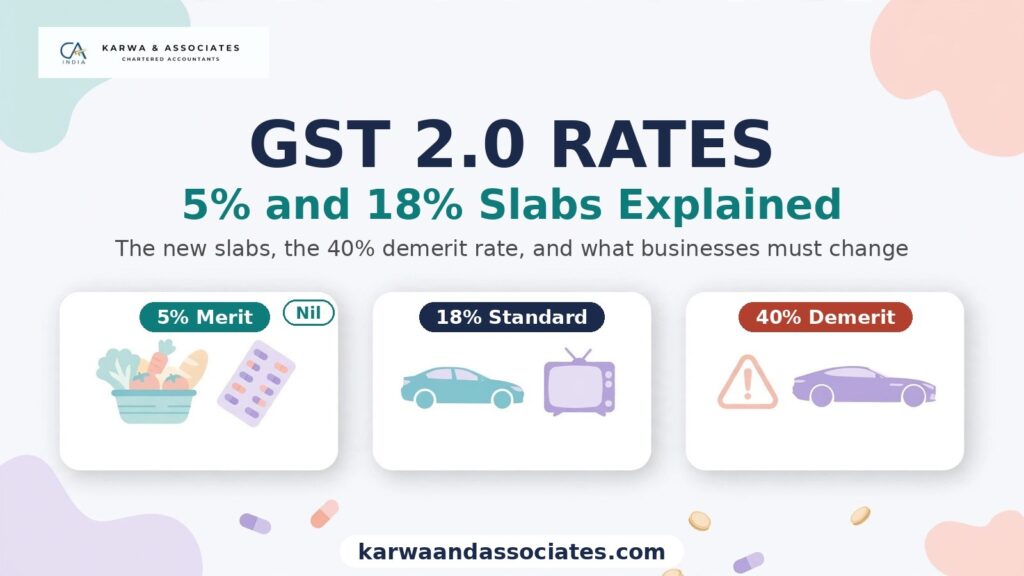
GST 2.0 rates are the new GST rates that have applied in India since 22 September 2025. On 3 September 2025, the 56th GST Council meeting recommended replacing the old four-slab structure with two main rates, a merit rate of 5% and a standard rate of 18%, plus a special demerit rate of 40% for a small list of luxury and sin goods. The Government notified the new rates on 17 September 2025, and they took effect on the first day of Navratri.
This is the biggest GST rate change since the tax began in 2017. Essentials, food, medicines, farm inputs, vehicles, electronics, cement, textiles, insurance and hotel stays all changed rate on the same day, and compensation cess was withdrawn for most goods. The tobacco and pan masala transition followed separately on 1 February 2026.
This post is a guide, not breaking news. The answers here come from the official sources: the Press Information Bureau release of 3 September 2025, the CBIC rate notifications, and the CGST Act itself.
Key Takeaways
- GST 2.0 replaced the old 5%, 12%, 18% and 28% slabs with two main rates, 5% and 18%, plus a 40% demerit rate, from 22 September 2025.
- Essentials moved to nil: UHT milk, pre-packaged paneer and Indian breads from 5%, 33 life-saving drugs from 12%, and individual life and health insurance from 18%.
- Compensation cess was withdrawn for most goods from 22 September 2025, and for tobacco and pan masala from 1 February 2026.
- Where a transaction spans 22 September 2025, Section 14 decides the rate: whichever side holds two of the three events (supply, invoice, payment), that rate applies.
Table of Contents
GST 2.0 Rates: The Old Slabs and the New Slabs
Before 22 September 2025, GST ran on four main slabs, 5%, 12%, 18% and 28%, with a nil rate for some essentials and compensation cess on top for a short list of luxury and sin goods. GST 2.0 collapses that structure. The 12% slab is gone: almost everything in it moved to 5%. The 28% slab is gone for the goods covered by this guide: most of it moved to 18%, and a small remainder moved to the new 40% demerit rate. A 28% rate survives for a small set of specified goods outside this guide. The 5% and 18% rates are now the only two main rates, and the nil rate continues for notified essentials.
| Old position | New position | What moved |
|---|---|---|
| 5% | Nil | UHT milk, pre-packaged labelled paneer, Indian breads |
| 12% | Nil | 33 life-saving drugs |
| 5% | Nil | 3 life-saving drugs for cancer, rare diseases and severe chronic diseases |
| 18% | Nil | Individual life and health insurance (and reinsurance) |
| 12% | 5% | Almost all goods earlier at 12%: food, medicines, farm inputs, bicycles, toiletries, textiles |
| 18% | 5% | Hair oil, shampoo, toothpaste, tractor tyres and parts, medical apparatus, gyms, salons, yoga centres |
| 28% | 18% | Air conditioners, all TVs, dishwashers, small cars, motorcycles up to 350 cc, cement, buses, trucks, three-wheelers, all auto parts |
| 28% | 40% | Large cars, motorcycles above 350 cc, aerated drinks, pan masala, tobacco, betting and gaming, personal aircraft and yachts |
| 28% plus cess | 18% or 40%, cess withdrawn | Cars and aerated drinks from 22 September 2025; tobacco and pan masala from 1 February 2026 |
The legal basis is CBIC Notification No. 9/2025-Central Tax (Rate) dated 17 September 2025 for goods and Notification No. 10/2025-Central Tax (Rate) dated 17 September 2025 for services. Rates are set item by item using HSN codes for goods and SAC codes for services, so a category name is never enough on its own. Check the exact HSN or SAC in the current notification before invoicing.
GST 2.0 Rates: What Changed for Food, Medicine and Daily Essentials
The largest relief went to daily essentials, food and healthcare. Several staples moved to nil: ultra-high temperature (UHT) milk from 5%, pre-packaged and labelled chena or paneer from 5%, and all Indian breads (chapati, roti, paratha and parotta). Food moved broadly from 12% or 18% to 5%: packaged namkeens, bhujia, sauces, pasta, instant noodles, chocolates, coffee, preserved meat, cornflakes, butter, ghee, condensed milk and cheese.
Daily use goods moved from 18% or 12% to 5%: hair oil, toilet soap bars, shampoos, toothbrushes, toothpaste, bicycles, tableware, kitchenware and other household articles.
Healthcare saw the sharpest cuts. GST on 33 life-saving drugs and medicines was reduced from 12% to nil, and on 3 more (used for cancer, rare diseases and other severe chronic diseases) from 5% to nil. All other drugs and medicines moved from 12% to 5%. Medical apparatus and devices moved from 18% to 5%, and diagnostic kits, glucometers, wadding, gauze and bandages moved from 12% to 5%.
The most valuable change for households was insurance. GST on all individual life insurance policies, whether term life, ULIP or endowment, and on reinsurance of those policies, was exempted entirely. GST on all individual health insurance policies, including family floater policies and policies for senior citizens, and on reinsurance of those policies, was also exempted. A family renewing a health policy now pays no GST on the premium.
GST 2.0 Rates: Vehicles, Electronics, Cement and Textiles
Vehicles, electronics and building materials were the other big winners, because most of them sat in the 28% slab before. Small cars moved from 28% to 18%, and motorcycles with engine capacity up to 350 cc moved from 28% to 18%. Buses, trucks and ambulances moved from 28% to 18%, three-wheelers moved from 28% to 18%, and all auto parts now carry a uniform 18% irrespective of their HS code, which ends the old problem of the same part attracting different rates under different headings. Only larger cars and motorcycles above 350 cc went the other way, to 40%.
Consumer electronics moved the same way. Air-conditioning machines moved from 28% to 18%, dishwashing machines moved from 28% to 18%, and all television sets, of every size, moved to 18%. Cement, one of the most widely used building materials in the country, moved from 28% to 18%.
Farm goods and inputs moved down sharply. Tractors moved from 12% to 5%, tractor tyres and parts moved from 18% to 5%, and farm machinery for soil preparation, cultivation, harvesting and threshing moved from 12% to 5%. Bio-pesticides, micronutrients, drip irrigation systems and sprinklers moved from 12% to 5%.
Textiles saw a correction of a long-standing inverted duty structure. Man-made fibre moved from 18% to 5% and man-made yarn moved from 12% to 5%. Readymade garments and made-ups now attract 5% up to Rs 2,500 per piece, where the earlier threshold was Rs 1,000 per piece. Handicrafts moved from 12% to 5%, including 36 handicraft items and handloom cotton rugs.
GST 2.0 Rates: Services, Insurance and Hotels
Services changed on the same date, 22 September 2025. Insurance is covered in the essentials section above: individual life and health insurance are now exempt, so no GST at all falls on the premium. Group insurance and general insurance other than the exempt categories continue at their notified rates.
Hotel accommodation services with a value up to Rs 7,500 per unit per day moved from 12% to 5%. Beauty and physical well-being services used by the common man moved from 18% to 5%, including services of gyms, salons, barbers and yoga centres.
GST 2.0 Rates: The 40% Demerit Rate
The 40% rate is the demerit rate. It applies to a short, specific list of luxury and sin goods and services, and it replaced the 28% rate plus compensation cess for those items. Nothing else attracts 40%, and a business should never apply it by analogy to a product that is merely expensive.
| Category | Items at 40% |
|---|---|
| Tobacco and pan masala | Pan masala, unmanufactured tobacco, cigars, cheroots, cigarillos and cigarettes, other manufactured tobacco, tobacco and nicotine inhalation products |
| Drinks | Aerated waters with added sugar, other non-alcoholic beverages, carbonated fruit drinks, caffeinated beverages |
| Vehicles | Large motor cars (other than the small cars listed at 18%), large hybrid cars above the engine and length thresholds, motorcycles above 350 cc |
| Luxury goods | Aircraft for personal use, yachts and other vessels for pleasure or sports, revolvers and pistols, smoking pipes |
| Services | Leasing of goods attracting 40% GST; admission to casinos, race clubs and IPL-type sporting events; race club bookmaker licensing; specified actionable claims (betting, casinos, gambling, horse racing, lottery, online money gaming) |
Two points need care. First, tobacco and pan masala did not move to 40% on 22 September 2025. They stayed on their old rates plus compensation cess until 1 February 2026, for reasons explained in the cess section below. Second, specified actionable claims (betting, casinos, gambling, horse racing, lottery, online money gaming) are taxed at 40% with input tax credit, so a gaming or racing business must check the SAC entry, not assume 18%.
GST 2.0 Rates: Compensation Cess After the Change
Compensation cess was the extra levy charged on top of GST for a short list of luxury and sin goods. Its original purpose was to compensate states for revenue loss in the first five years of GST, and its collection was later extended to repay loans taken to fund that compensation during the pandemic.
From 22 September 2025, compensation cess was discontinued for most goods. Cars, aerated drinks and similar goods that used to carry 28% plus cess now carry 18% or 40% with no cess on top. The cess was folded into the headline rate rather than charged separately, which is why a large car that used to attract 28% plus cess now attracts a flat 40%.
Tobacco and pan masala were the exception. The Council decided they would continue at the existing rates of GST and compensation cess until the loan and interest obligations under the compensation cess account were completely discharged, and the Finance Minister would decide the actual date of transition. That date was 1 February 2026. From that day, pan masala, cigarettes and other tobacco products moved to 40% GST, bidi moved to 18%, and compensation cess was withdrawn entirely, so no compensation cess is leviable on any goods or service from 1 February 2026.
It was replaced by two levies outside GST: additional excise duty on tobacco products and the Health Security se National Security Cess on pan masala. GST on these goods is now charged on the retail sale price printed on the pack, under new Rule 31D of the CGST Rules, and the National Calamity Contingent Duty on tobacco continues unchanged.
One caution: the Health Security se National Security Cess has been challenged before the Karnataka High Court in Dhariwal Industries Pvt Ltd v Union of India, which upheld Parliament’s power to levy a cess but struck down the capacity-based method. A pan masala business must confirm the current legal position before acting; the verification path is in the Sources section below.
GST 2.0 Rates: Transitional Rules for Invoices Spanning 22 September 2025
The cutover date creates the hardest questions in GST 2.0, because a single transaction can have its supply, its invoice and its payment on different sides of 22 September 2025. The answer comes from Section 14 of the CGST Act, which fixes the time of supply when the rate changes. It looks at three events: when the goods or services were supplied, when the invoice was issued, and when payment was received. If two of the three events fall after the change, the new rate applies. If two fall before it, the old rate applies.
| Supply | Invoice | Payment | Rate that applies |
|---|---|---|---|
| Before 22 Sep 2025 | Before 22 Sep 2025 | Before 22 Sep 2025 | Old rate |
| Before 22 Sep 2025 | Before 22 Sep 2025 | After 22 Sep 2025 | Old rate |
| Before 22 Sep 2025 | After 22 Sep 2025 | After 22 Sep 2025 | New rate |
| After 22 Sep 2025 | Before 22 Sep 2025 | Before 22 Sep 2025 | Old rate |
| After 22 Sep 2025 | After 22 Sep 2025 | Before 22 Sep 2025 | New rate |
| After 22 Sep 2025 | After 22 Sep 2025 | After 22 Sep 2025 | New rate |
Three consequences follow. An advance received before the change does not by itself lock in the old rate. Goods supplied on or after 22 September 2025 carry the new rate whenever they were bought, because GST is levied on supply, not on purchase. And a business must keep the old rates available in its billing system for invoices that genuinely belong before the change.
Credit notes and debit notes follow the original invoice, not the current rate. A credit note for goods invoiced in August 2025 at 12% carries 12%, even if it is issued in October 2025 when the goods carry 5%. Input tax credit already taken stays usable against output tax at the lower rate. Two limits apply: where a product moved to nil, the credit attributable to its exempt supplies needs reversal; and where the same goods were bought at 12% and are now sold at 5%, that alone does not create an inverted duty structure refund claim.
The departmental position rests on CBIC Circular No. 173/05/2022-GST, which removed the restrictive portion of the earlier Circular No. 135/05/2020-GST, and on Question 10 of the GST 2.0 FAQs. High Courts have held otherwise: the Gauhati High Court in BMG Informatics Pvt Ltd v Union of India and the Karnataka High Court in South Indian Oil Corporation v Assistant Commissioner (2025) held the Circular 135 restriction unsustainable against Section 54(3)(ii), so take advice before relying on either position.
GST 2.0 Rates: What Businesses Must Change Now
The rates have been live for over a year, so treat this list as a check that the change was actually completed. If any item is still open, it is a live compliance gap.
- Item masters and HSN mapping. Update every item master to the current HSN-wise rate in Notification No. 9/2025-Central Tax (Rate) as amended, and every service to its SAC rate.
- Billing and ERP tax codes. Retire the 12% and 28% codes for fresh supplies, keep them only for pre-change invoices and credit notes, add the 40% code, and check the e-invoicing and IRP mapping carry the same rates.
- Price lists and MRPs. Decide, item by item, whether the rate cut is passed to the customer or retained. Tobacco and pan masala need the RSP-based calculation under Rule 31D from 1 February 2026.
- Contracts. Check open contracts for tax-change clauses. An order booked before 22 September 2025 but supplied after it takes the new rate under Section 14.
- GSTR-1 and GSTR-3B. Report HSN-wise details in Table 12 of GSTR-1 at the new rates, and check that GSTR-3B matches.
- Inverted duty and refunds. Where the rate cut left accumulated credit, check whether a refund is actually available. The 1 November 2026 amendments widened the 90% provisional refund, but a rate cut on the same goods is not by itself an inverted duty claim.
- Cess credit. If the electronic credit ledger still shows compensation cess credit, take advice before assuming it can be used or refunded.
- Customer communication. Tell trade customers which items changed rate and from when, so their credit claims match your invoices.
The 57th GST Council meeting of 7 and 8 October 2026 made no rate changes; its focus was process reforms. The rate structure in this guide is therefore the current structure.
GST 2.0 Rates: A Note for Rajasthan and Jaipur Readers
Rajasthan felt this change in the same way as the rest of the country, with two local notes. First, the textile and handicraft cuts matter here: Jaipur’s garment, handloom and handicraft trade benefits from the 5% band up to Rs 2,500 per piece and the 12% to 5% cut on handicrafts. Second, the tractor and farm machinery cuts matter to the agricultural districts around Jaipur. Rates are the same in every state, because GST rates are uniform.
GST 2.0 Rates: Frequently Asked Questions
When did GST 2.0 rates come into effect?
On 22 September 2025 for services and almost all goods. Pan masala, gutkha, cigarettes, chewing tobacco, unmanufactured tobacco and bidi moved later, on 1 February 2026.
What are the GST slabs now?
Two main slabs, 5% (merit rate) and 18% (standard rate), plus a nil rate for notified essentials and a 40% demerit rate for a short list of luxury and sin goods. The old 12% and 28% slabs no longer apply to fresh supplies of the goods covered by this guide; a 28% rate survives for a small set of specified goods outside it.
Which rate applies to an order booked before 22 September 2025 but supplied after it?
Section 14 of the CGST Act decides it from three dates: supply, invoice and payment. If two of the three fall after the change, the new rate applies.
Should a credit note for a pre-change invoice use the old rate or the new rate?
The old rate. A credit note reverses the original supply, so it carries the tax rate of the original invoice.
Is compensation cess still charged on anything?
No. It was withdrawn for most goods from 22 September 2025 and for tobacco and pan masala from 1 February 2026. Note the caution in the cess section above about the legal challenge to the Health Security se National Security Cess.
Sources
- PIB, Ministry of Finance, “Recommendations of the 56th Meeting of the GST Council”, 3 Sep 2025: https://www.pib.gov.in/PressReleasePage.aspx?PRID=2163555
- PIB, Ministry of Textiles, “Next-Generation GST Reforms Boosts India’s Textiles Sector”, 4 Sep 2025: https://www.pib.gov.in/PressReleasePage.aspx?PRID=2163905
- CBIC Notification No. 9/2025-Central Tax (Rate), 17 Sep 2025 (goods rates, in force 22 Sep 2025)
- CBIC Notification No. 10/2025-Central Tax (Rate), 17 Sep 2025 (services rates, in force 22 Sep 2025)
- CBIC Notification No. 19/2025-Central Tax (Rate), 31 Dec 2025 (tobacco and pan masala to 40%, bidi to 18%, in force 1 Feb 2026)
- Section 14, CGST Act, 2017 (time of supply on change in rate of tax)
- CBIC Circular No. 173/05/2022-GST dated 6 July 2022 (removed the restrictive portion of Circular No. 135/05/2020-GST on inverted duty structure refunds for the same goods at different rates); GST 2.0 FAQs, Question 10 (departmental position that a rate cut on the same goods does not by itself create an inverted duty refund claim); Gauhati High Court, BMG Informatics Pvt Ltd v Union of India, and Karnataka High Court, South Indian Oil Corporation v Assistant Commissioner (2025 (12) TMI 1537), holding the Circular 135 restriction unsustainable against Section 54(3)(ii)
- Ministry of Finance notifications of 31 Dec 2025 and 1 Jan 2026 (additional excise duty on tobacco, Health Security se National Security Cess on pan masala, Rule 31D)
- Karnataka High Court, Dhariwal Industries Pvt Ltd v Union of India, W.P. No. 3157 of 2026, judgment pronounced 13 July 2026, Justice M. Nagaprasanna
- Karwa and Associates, “Highlights of 56th GST Council Meeting – September 2025”: https://karwaandassociates.com/highlights-of-gst-council-meeting-september-2025/
- Karwa and Associates, “57th GST Council Meeting 2026: Major Reliefs and Key GST Reforms”: https://karwaandassociates.com/57th-gst-council-meeting-2026-major-reliefs-and-key-gst-reforms/
- Karwa and Associates, “GST Amendments Effective 1 November 2026: Discounts, Credit Notes, Refunds and Delivery Services”: https://karwaandassociates.com/gst-amendments-1-november-2026/
About the Author
This guide was prepared by the indirect tax team at Karwa and Associates, a team of Chartered Accountants practising in Jaipur since 1991. The team advises businesses on GST registration, returns, refunds, litigation and rate and classification questions, and appears before GST authorities and appellate forums across India. For businesses not yet registered, our GST registration service covers the documents, timeline and fees.
Karwa and Associates is based in Jaipur and serves clients across India and globally.
Found this useful? Add Karwa and Associates as a preferred source on Google to see our latest tax and compliance updates more often:

CA Anshul Karwa is a Chartered Accountant (DISA-qualified) and Partner at Karwa & Associates, Chartered Accountants, Jaipur. A non-commerce student who cleared CA in the first attempt, he worked with Big 4 firms and MNCs before joining the firm. He also builds digital apps, websites and tools for CAs, founders and other professionals, and writes books on investing.