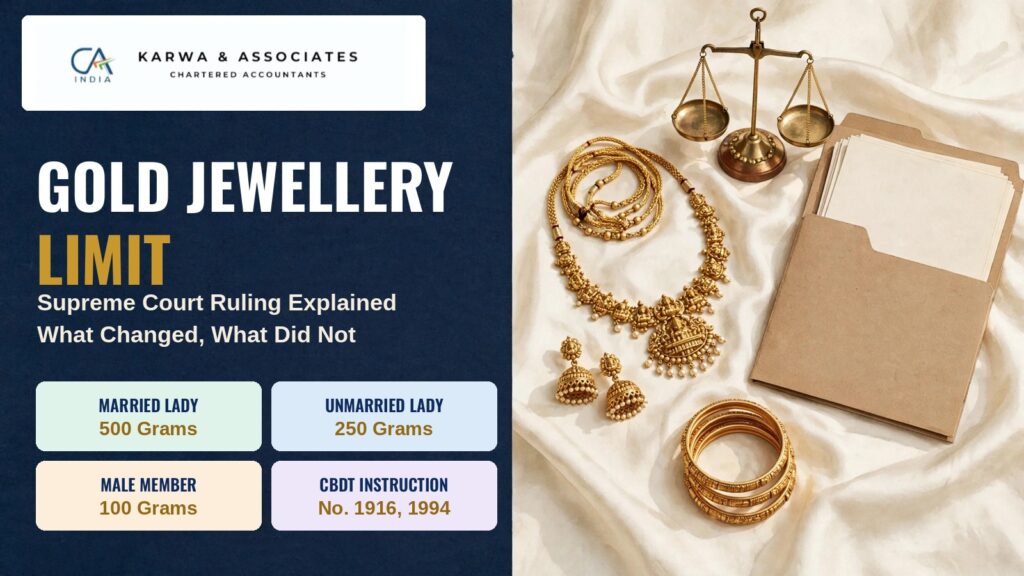
A short video is doing the rounds this week claiming that the Supreme Court has changed how much gold your family is allowed to keep, and that you now need a bill for every gram or the gold can be seized and you can be prosecuted. The judgment behind the video is real, and it matters. But it does not say what the video says it says. This guide sets out the gold jewellery limit as it actually stands, what the Supreme Court decided on 2 November 2026 in State of Bihar v. Phulpari Kumari, and the paperwork a family should keep so that its gold is never in question.
Table of Contents
Gold jewellery limit: the 1994 rule everyone quotes
The gold jewellery limit that most families know comes from Instruction No. 1916, issued by the Central Board of Direct Taxes on 11 May 1994. It was written for one specific situation: a search under Section 132 of the Income Tax Act, where officers find jewellery in a home and must decide, on the spot, what to seize.
The instruction says three things. First, if the person is assessed to wealth tax, only the jewellery in excess of the weight declared in the wealth tax return needs to be seized. Second, if the person is not assessed to wealth tax, gold jewellery and ornaments up to a set weight per family member need not be seized. Third, the authorised officer may exclude an even larger quantity from seizure, keeping in mind the status of the family, the customs and practices of the community, and the circumstances of the case.
| Family member | Weight that need not be seized |
|---|---|
| Married lady | 500 grams |
| Unmarried lady | 250 grams |
| Male member of the family | 100 grams |
On these numbers, a family of two married ladies, one unmarried daughter and one son could hold well over a kilogram of gold jewellery that officers are told not to seize. The Ministry of Finance repeated the same limits in a press release on 1 December 2016, when rumours about gold holding limits were spreading after demonetisation. That press release is why the 500 gram figure is so widely known.
Read the instruction carefully and one limit is built into it: it governs seizure during a search. It does not say the gold is explained, and it does not bar the tax department from asking where the gold came from. Courts have read it exactly this way for years. That distinction is the whole story of the new judgment.
Gold jewellery limit in the Phulpari Kumari case: what actually happened
Phulpari Kumari is a former Child Development Project Officer in Bihar, which makes her a public servant in law. In May 2015, the Vigilance Police Station in Patna registered a case against her and her husband under the Prevention of Corruption Act, 1988, alleging that the couple owned assets disproportionate to their known sources of income. The trial court took cognizance of the case in January 2021.
Gold jewellery weighing 646.400 grams was found with her and her unmarried daughter. Her defence leaned on the tax department’s own numbers: counted under Instruction No. 1916 and the 2016 press release, her family’s permissible limit came to 750 grams, so, she argued, the gold was within the limit and the vigilance department had seized it wrongly. The Patna High Court accepted that argument and, in May 2026, quashed the prosecution altogether. The State of Bihar appealed to the Supreme Court.
Gold jewellery limit and the Supreme Court: what the Court held
A bench of Justice K.V. Viswanathan and Justice Arun Palli decided the appeal on 2 November 2026 (Criminal Appeal No. 5212 of 2026). The Court set aside the High Court’s order, restored the cognizance order of January 2021, and directed that the prosecution proceed from that stage.
The reasoning is short and worth quoting: “Merely showing certain press release and circulars permitting the holding of gold to a certain extent will not amount to accounting for the possession of the said assets.” In a prosecution for disproportionate assets, the Court said, the accused is called upon to explain the assets against known sources of income. Being allowed to hold gold, and being able to account for it, are two different things. The first comes from a tax circular. The second has to come from evidence of income and acquisition.
Two cautions belong here. The judgment restores a trial; it does not convict anyone, and the allegations against the respondent remain to be tested, with the presumption of innocence intact. And the case arises under the Prevention of Corruption Act, which applies to public servants. It is not an income tax case, and it does not rewrite any income tax rule.
Gold jewellery limit: what did not change for ordinary families
For a normal household, the position after this judgment is the position before it:
- The gold jewellery limit in Instruction No. 1916 still guides officers during an income tax search. Jewellery within 500 grams per married lady, 250 grams per unmarried lady and 100 grams per male member need not be seized, and the officer can spare more, looking at family status and community custom.
- The judgment does not create any new offence of holding gold, and it sets no new ceiling on how much gold a family may own. There has never been a legal ceiling on ownership; the circular is about seizure, not permission.
- What the judgment confirms, for everyone and not only public servants, is the difference between possession and proof. If any authority, tax or otherwise, ever asks how the gold was acquired, the circular alone is not an answer. Bills, gifts and inheritance records are.
So the honest summary is this: the Supreme Court did not touch your locker. It told one accused public servant that a tax circular cannot do the work of accounting for her assets. The practical lesson travels beyond her case, which is why the next section matters.
Gold jewellery limit: the proof you should keep
Gold in Indian families arrives over decades: purchases, wedding gifts, inheritance from parents and grandparents, pieces exchanged or remade by the family jeweller. Nobody keeps every bill, and the law does not expect miracles. It expects a reasonable paper trail that fits the family’s income and history. Build it like this:
- Purchase bills: keep jeweller invoices for every purchase from now on, in one folder, physical or scanned. Ask for the bill even on small purchases; it takes a minute.
- Gift records: for gold received as a gift, a simple gift deed or even a written note from the giver, with the date and occasion, is far better than nothing. Close relatives can gift without tax in the receiver’s hands, but the record still helps.
- Inheritance records: keep the will, succession papers, or a family settlement note that mentions the jewellery. Where gold came from a parent or grandparent, a short written declaration by the family, signed and dated, creates a trail where none existed.
- Wedding records: wedding invitation cards, photographs and the traditional gift lists families maintain are genuine supporting evidence of gold received at a marriage. Keep them with the folder.
- Old gold with no papers: for jewellery held for generations, a one-time valuation report from a registered valuer, recording the items and their weight, gives the holding a dated, independent record. Families often do this when they make or update a will.
- Bank and locker records: locker agreements and bank statements showing payments to jewellers quietly corroborate the story. Keep statements for years in which large purchases were made.
Gold jewellery limit: when you should take advice
Most families will never face a question about their gold, and this judgment gives them no new reason to worry. Take advice promptly in three situations: a public servant in the family facing a disproportionate assets inquiry of any kind; a search or survey by the tax department where jewellery has been inventoried; and any notice that treats jewellery as unexplained. In each of these, the work is the same: match the gold, item by item, to income, gifts and inheritance, with documents. Done early and calmly, it is a paperwork exercise. Done late, it becomes litigation.
Karwa and Associates advises families and public servants on asset documentation, search assessments and disproportionate assets matters. We are based in Jaipur and serve clients across India and globally. Reach us on 0141-2603671-72 or at anshul@karwaandassociates.com.
Frequently asked questions
Has the Supreme Court reduced the 500 gram gold limit?
No. The 500 gram figure comes from CBDT Instruction No. 1916 of 1994 and concerns seizure during an income tax search. The Supreme Court’s November 2026 judgment does not change it. The judgment says the circular cannot, by itself, account for gold in a disproportionate assets prosecution under the Prevention of Corruption Act.
Can the tax department seize gold below the limit?
Under the 1994 instruction, jewellery within the stated weights need not be seized in a search, and officers can spare larger quantities looking at family status and custom. Seizure is different from assessment: the department may still ask for the source of the gold in assessment proceedings, which is why keeping bills and gift or inheritance records is wise.
Does this judgment apply to everyone or only government employees?
The case itself is against a public servant under the Prevention of Corruption Act, so its direct ruling is in that setting. Its reasoning, that holding within a limit is not the same as accounting for an asset, is the part every gold holder should understand.
Our family gold is generations old and has no bills. What should we do?
Do not panic and do not fabricate papers. Record what exists: a family declaration of how the jewellery came down, any old wills or wedding records, and a registered valuer’s report listing the items and weights. That combination is the standard, honest way to document inherited gold.