
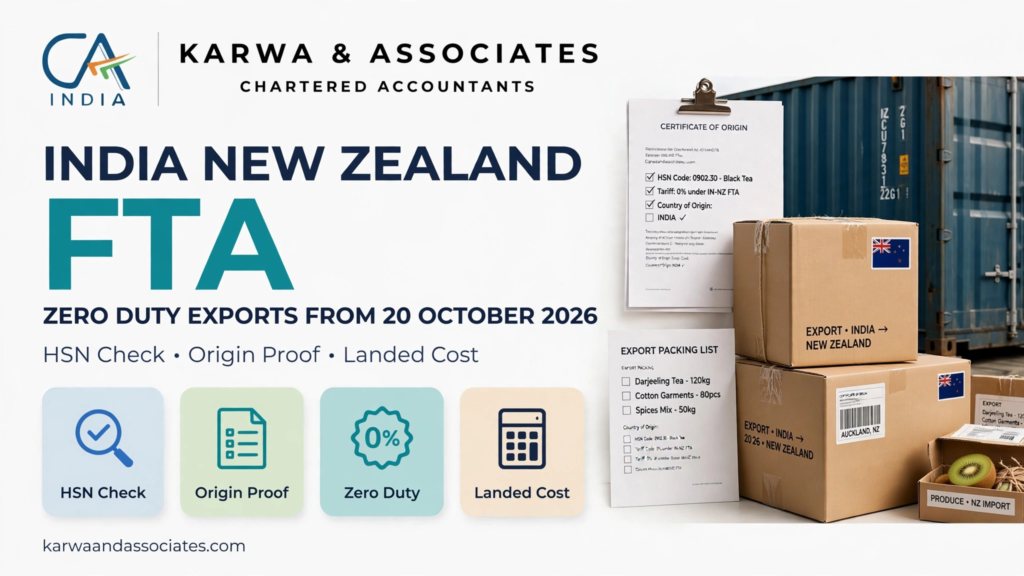
The India New Zealand FTA is now in force, and for Indian exporters it changes the landed cost in New Zealand from the first shipment. The key is to claim it correctly. Duty free does not mean document free.
Table of Contents
India New Zealand FTA: Official source
The New Zealand India Free Trade Agreement entered into force on 20 October 2026. It was signed in New Delhi on 27 April 2026, after negotiations launched on 16 March 2025 and substantively concluded on 22 December 2025. Ratification was completed on 21 September 2026.
See the New Zealand Ministry of Foreign Affairs and Trade timeline and the Press Information Bureau release on entry into force on 20 October 2026.
India New Zealand FTA: What actually changed on 20 October 2026
New Zealand has eliminated customs duty on 100 percent of tariff lines covering Indian exports, from day one. This is the first Indian FTA to give full duty free access from entry into force.
Before the FTA, Indian exporters faced duties of up to 10 percent in New Zealand on several lines, including textiles, ceramics, carpets, automobiles and auto components. That 10 percent disadvantage is now removed, if the goods qualify.
Sectors named in official and trade coverage include textiles and apparel, leather and footwear, gems and jewellery, engineering goods, automobiles and auto components, chemicals, pharmaceuticals, processed foods, marine products, plastics and rubber, and fruits, vegetables, cereals, coffee, tea, cocoa and spices.
India, in return, gave concessions on about 70 percent of its tariff lines, covering about 95 percent of current bilateral trade value. Dairy and several sensitive farm products remain excluded on the India side. Do not confuse the two directions. The 100 percent figure applies to India to New Zealand exports.
Bilateral merchandise trade was about $1.1 billion in FY26. The two countries have set an aspirational target to double goods and services trade to NZ$7 billion by 2030. This is a small market today with room to grow, not a market where every MSME will get an order tomorrow.
India New Zealand FTA: A worked example, so the saving is clear
This is illustrative, for a shipment where the old New Zealand duty was 10 percent. Your actual saving depends on your HSN and your old duty rate.
| Item | Amount |
|---|---|
| Invoice value | Rs 10,00,000 |
| Old New Zealand customs duty at 10 percent | Rs 1,00,000 |
| New customs duty under FTA, if origin is proved | Rs 0 |
| Saving on duty | Rs 1,00,000 |
Invoice value: Rs 10,00,000. Old New Zealand customs duty at 10 percent: Rs 1,00,000. New customs duty under FTA, if origin is proved: Rs 0. Saving on duty: Rs 1,00,000.
What does not change: freight, insurance, port charges, and New Zealand GST on imports. A buyer who was quoted a landed price with duty included should get a revised landed price, not just a lower invoice price. That revised quote is where many first time FTA exporters win or lose the order.
India New Zealand FTA: The 5 checks before you claim zero duty
- Check your HSN in the New Zealand tariff schedule. Confirm the line is covered and what the pre FTA rate was. Do not rely on a sector headline.
- Check your product specific origin rule. Some goods qualify because they are wholly obtained in India. Others qualify only if they meet a processing or value addition rule in the agreement annex. If you use imported inputs, this check is mandatory.
- Choose the right proof of origin. India recognises a Certificate of Origin issued by the designated authority, or an origin declaration by an eligible exporter. The proof is valid for 12 months from issue. Get this agreed before shipment, not after.
- Match your documents exactly. Commercial invoice, packing list, bill of lading and origin document must agree on product description, quantity and exporter details. A mismatch is the most common reason for a preference claim to be questioned at arrival.
- Recalculate landed cost and quote. Show the buyer the old duty, the new zero duty, and the costs that remain. Keep a copy of the origin proof, production records and input invoices for audit. Preferential claims can be verified later.
What a CA check should also cover under the India New Zealand FTA, beyond customs duty
IEC, AD code and bank realisation under FEMA. GST on exports, LUT status, and e invoice if applicable.
Pricing: whether the duty saving goes to you, to the buyer, or is shared to win the order.
Input costs: New Zealand inputs such as wooden logs, coking coal and metal scrap are also duty free into India for Indian manufacturers, check if that helps your cost.
Product standards in New Zealand: labelling, food safety, pharma and medical device rules where applicable. Duty free does not waive standards.
Who should act first
Exporters already selling to New Zealand, Australia or the UK, who can add New Zealand with the same product.
MSMEs with a live enquiry from a New Zealand buyer, where a revised landed quote can close the deal.
Textile, apparel, leather, gems and jewellery, engineering and processed food exporters, where the old duty was a real disadvantage.
First time exporters should not start with New Zealand alone. Start with one buyer, one product and one fully documented shipment.
The India New Zealand FTA gives these exporters a clear reason to requote, if origin is proved.
What not to do
Do not promise a buyer zero duty before the HSN and origin check. Do not ship goods made mainly from third country inputs and claim Indian origin. Do not mix originating and non originating goods in one consignment without separate documentation. Do not treat the FTA as a substitute for a purchase order, distribution or payment terms.
FTA starter check from Karwa and Associates
For an exporter who wants to use the India New Zealand FTA correctly, a starter check covers:
- HSN and old duty rate for your product in New Zealand.
- Product specific origin rule for that HSN.
- Proof of origin route for your shipment.
- Document matching checklist for invoice, packing list and bill of lading.
- Revised landed cost quote for your New Zealand buyer.
- GST, LUT, IEC and FEMA checklist for the export.
- A short note on what to keep on file if customs verifies the claim later.
If you have a product and a buyer in mind, send the HSN, product description and input details, and the check can be done for that product before you quote.
Contact Karwa and Associates through the contact page.
India New Zealand FTA: Frequently asked questions
Is every Indian product now duty free in New Zealand? New Zealand removed duty on 100 percent of tariff lines for Indian exports, but your product must still meet the origin rule and you must support the claim with proof of origin.
Is duty free the same as tax free? No. Customs duty is zero if you qualify. Freight, insurance, port charges and New Zealand GST on imports still apply.
Do I need a Certificate of Origin for every shipment? You need a valid proof of origin for the claim. That can be a Certificate of Origin from the designated authority or an origin declaration by an eligible exporter, as notified. Confirm which route applies to you before shipment.
Does the FTA help if I import from New Zealand? That is a different direction. India gave concessions on about 70 percent of lines, not 100 percent, and sensitive products like dairy remain excluded. Check the India schedule separately.
Can an MSME afford to claim FTA benefit? Yes, if the shipment value is large enough to cover documentation cost. For a very small first order, do the landed cost maths first. A starter check is cheaper than a rejected claim.
Disclaimer
This is general information on the India New Zealand FTA as in force from 20 October 2026. It is not a customs ruling for a specific shipment. Duty, origin and standards depend on your HSN, inputs and buyer requirements. Check the official text and tariff schedule for your product before quoting or shipping.
About the Author
Written and reviewed by CA Anshul Karwa, Chartered Accountant (DISA-qualified) associated with Karwa and Associates, Chartered Accountants, Jaipur. Karwa and Associates serves clients across India and globally.
This guide covers the India New Zealand FTA for Indian exporters.

CA Anshul Karwa is a Chartered Accountant (DISA-qualified) and Partner at Karwa & Associates, Chartered Accountants, Jaipur. A non-commerce student who cleared CA in the first attempt, he worked with Big 4 firms and MNCs before joining the firm. He also builds digital apps, websites and tools for CAs, founders and other professionals, and writes books on investing.