
Table of Contents
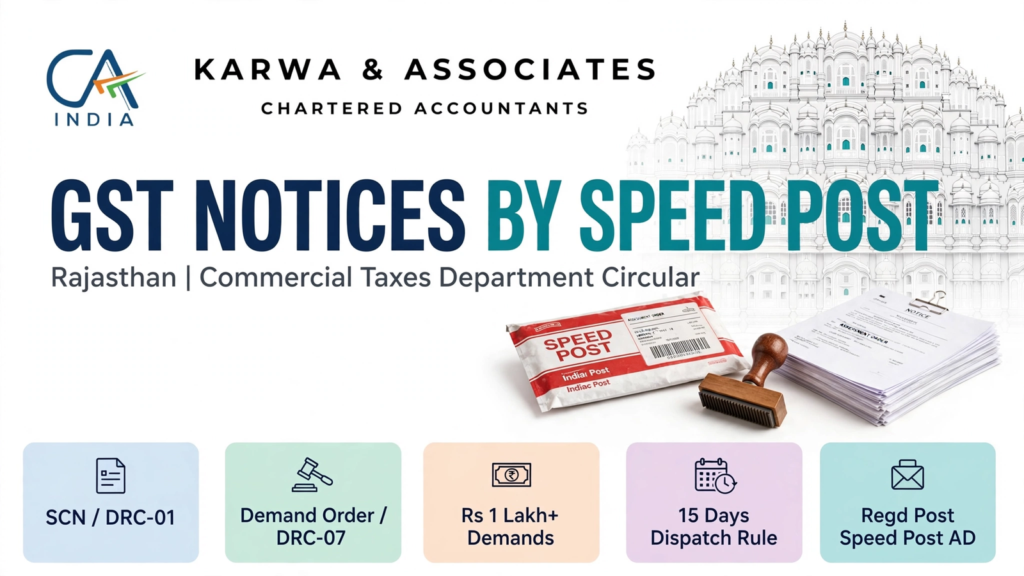
The Commercial Taxes Department, Rajasthan has introduced a new GST SCN speed post rule for communicating high-value GST notices. Under the circular issued by the Chief Commissioner, State Tax, show cause notices and demand orders involving a demand of Rs 1 lakh or more will now also be sent to taxpayers by registered post or speed post with acknowledgement due, in addition to being served on the GST common portal.
This is a significant procedural change for businesses in Rajasthan. Until now, service through the GST portal was the primary mode, and many taxpayers first learned of demands only when checking the portal. The new direction adds a physical layer of intimation for all substantial demands, while keeping the legal position clear: the date of service remains the date the notice appears on the portal.
Official Circular: Download the Rajasthan GST Direction
The direction discussed in this article comes from the Commercial Taxes Department, Rajasthan circular F.17 (134) ACCT/GST/2017/PART-II (RajKaj Ref No. 25007477), dated 12 October 2026, issued under Section 168 of the RGST Act, 2017. Download the official circular (PDF)
Table of Contents
- GST SCN Speed Post: What the Circular Mandates
- Which Notices and Orders Are Covered
- GST SCN Speed Post: The 15-Day Dispatch Rule
- Deemed Receipt: The Portal Date Still Governs
- Why the Department Issued This Direction
- GST SCN Speed Post: What Taxpayers Should Do
- Frequently Asked Questions
- How Karwa & Associates Can Help
GST SCN Speed Post: What the Circular Mandates
The instructions have been issued under Section 168 of the Rajasthan Goods and Services Tax Act, 2017 (F.17 (134) ACCT/GST/2017/PART-II, RajKaj Ref No. 25007477). The core direction is simple: every show cause notice in FORM GST DRC-01 and every demand order in FORM GST DRC-07 that carries a total demand of Rs 1 lakh or more, and which has already been issued and served through the GST common portal, must additionally be sent by the jurisdictional Proper Officer through registered post or speed post with acknowledgement due.
The postal intimation goes to the person for whom the notice or order is intended, or their authorised representative, at the last known place of business or residence. The circular describes this second dispatch as being for the purpose of intimation only, which is an important qualification discussed below.
Which Notices and Orders Are Covered
The GST SCN speed post direction applies to notices and orders issued under the following provisions:
- Section 73 of the RGST/CGST Act: determination of tax not paid, short paid, or erroneously refunded, or input tax credit wrongly availed, for reasons other than fraud
- Section 74: the same determination where fraud, wilful misstatement or suppression of facts is involved
- Section 74A: the newer consolidated determination provision for the period from FY 2024-25 onwards
- Section 122: penalty provisions for specified offences
- The corresponding provisions of the IGST Act, 2017 (Section 20) and the GST (Compensation to States) Act, 2017
The monetary threshold is a total demand of Rs 1 lakh or more. Demands below this threshold continue to be served through the portal alone, with no postal intimation required.
GST SCN Speed Post: The 15-Day Dispatch Rule
Timing is the sharpest part of the circular. The jurisdictional Proper Officer must ensure that the postal intimation is dispatched within fifteen days of the issuance of the notice or order on the GST common portal. Under the GST SCN speed post instruction, this is a hard administrative deadline on the department, not on the taxpayer.
Compliance will be tracked through a dispatch register maintained office-wise, which the Proper Officer must monitor on a fortnightly basis. The Additional Commissioner of State Tax for the district will supervise the process and countersign the registers every month, which signals that the department intends to enforce this seriously.
Deemed Receipt: The Portal Date Still Governs
Here is the point taxpayers must not misunderstand. The circular states that the notice or order shall be deemed to have been received on the date it is made available on the GST common portal, in accordance with Section 169(1)(d) and Section 169(2) of the Act. The speed post letter is an additional intimation; it does not reset or extend the clock.
In practical terms, the time limit for filing a reply to an SCN or an appeal against a demand order runs from the portal date, not from the date the physical letter arrives. A taxpayer who waits for the speed post envelope before acting could easily miss a statutory deadline. The postal intimation is a safety net, not a fresh starting point.
Why the Department Issued This Direction
The circular itself records the background. The department cites regular feedback and representations from trade and industry, along with judicial pronouncements that have underlined the necessity of communicating GST notices and orders by post as well. Courts have, in several cases, examined whether taxpayers genuinely had knowledge of portal-issued notices, particularly where large demands were confirmed ex parte.
By mandating postal intimation for demands of Rs 1 lakh and above, the department is building a stronger evidentiary record that the taxpayer was informed, which should reduce litigation over alleged non-service in high-stakes cases.
GST SCN Speed Post: What Taxpayers Should Do
The new GST SCN speed post procedure helps taxpayers, but only if the basics are in order. Here is a practical checklist:
- Keep your registered address updated on the GST portal. The letter goes to the last known place of business or residence, so an outdated address means the intimation goes astray.
- Check the portal notices tab regularly. Limitation runs from the portal date, and the 15-day postal window does not pause it.
- Keep your authorised representative’s details current so the intimation reaches the right person without delay.
- Act on SCNs immediately. A show cause notice is the stage where a well-drafted reply can still prevent a demand order. Do not wait for the physical post.
- Preserve the postal envelope and acknowledgement when it arrives; the dispatch date on it can be relevant evidence in service disputes.
Frequently Asked Questions
Does the speed post letter extend my reply deadline?
No. The notice is deemed received on the date it appears on the GST portal under Section 169. Timelines for replies and appeals run from the portal date.
What is the minimum demand for postal intimation?
The circular applies where the total demand is Rs 1 lakh or more. Smaller demands are served through the portal only.
Which forms are covered?
SCNs in FORM GST DRC-01 and demand orders in FORM GST DRC-07, issued under Sections 73, 74, 74A or 122.
How quickly must the department post the letter?
Within 15 days of issuing the notice or order on the GST portal, as per the GST SCN speed post circular.
Where will the letter be sent?
To the taxpayer or their authorised representative at the last known place of business or residence, by registered post or speed post with acknowledgement due.
How Karwa & Associates Can Help
GST litigation is won or lost on procedure as much as on merits. Our team at Karwa & Associates, Chartered Accountants, Jaipur regularly handles SCN replies, demand orders and appeals under Sections 73, 74 and 74A, and we track every notice against its statutory timeline so nothing slips. If you have received a notice, or want a preventive review of your GST filings before the department comes calling, talk to our GST team here. For background on the department that issued this circular, see the official Rajasthan Commercial Taxes Department website.
Reference: Commercial Taxes Department, Rajasthan circular F.17 (134) ACCT/GST/2017/PART-II (RajKaj Ref No. 25007477), dated 12-10-2026, issued under Section 168 of the RGST Act, 2017. If you have questions on the GST SCN speed post rule and
how it affects your business, contact us.
About the Author
Written and reviewed by CA Anshul Karwa, Chartered Accountant (DISA-qualified) associated with Karwa & Associates, Chartered Accountants, Jaipur. He advises businesses on GST litigation, assessments and appeals before GST authorities.