
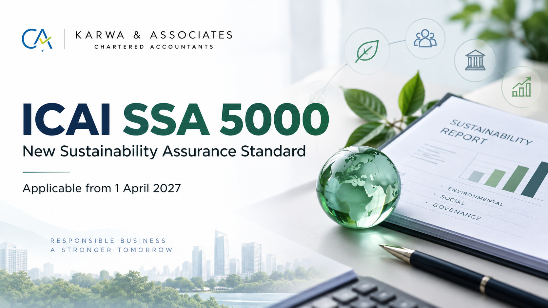
ICAI SSA 5000 : Sustainability reporting is no longer limited to environmental disclosures. Companies are increasingly reporting information relating to climate, emissions, workforce, biodiversity, governance and other sustainability matters.
The next question is equally important:
How reliable is the sustainability information being reported?
To address the assurance side of sustainability reporting, the Institute of Chartered Accountants of India, ICAI, has issued the new Standard on Sustainability Assurance, SSA 5000, titled “General Requirements & Framework for Sustainability Assurance Engagements”.
The new standard is aligned with the International Auditing and Assurance Standards Board’s, IAASB, International Standard on Sustainability Assurance, ICAI ISSA 5000, with certain India-specific carve-outs. It will apply to financial years beginning on or after 1 April 2027.
The introduction of SSA 5000 is expected to bring a common principles based approach to sustainability assurance across different reporting frameworks and sustainability topics.
What is SSA 5000?
SSA 5000 is ICAI’s new framework for sustainability assurance engagements.
In simple terms, sustainability reporting tells stakeholders what an entity is reporting about its sustainability performance. Sustainability assurance adds independent scrutiny over that information.
For example, sustainability information may relate to:
- Greenhouse gas emissions
- Energy consumption
- Water usage
- Waste management
- Employee related information
- Labour practices
- Biodiversity
- Social and community related matters
- Other environmental, social and governance information
The international ISSA 5000 framework is designed to work across different sustainability topics and reporting frameworks rather than being restricted to one particular ESG reporting model.
The Indian SSA 5000 follows this broad approach while incorporating India-specific changes.
When will SSA 5000 apply?
SSA 5000 will apply to financial years beginning on or after 1 April 2027.
Therefore, for entities following the April to March financial year, the first regular financial year covered will generally be FY 2027-28.
This gives companies, assurance practitioners and other stakeholders time to prepare systems, processes, documentation and data controls before the new framework becomes applicable.
SSA 5000 and ISSA 5000, what is the connection?
SSA 5000 is aligned with IAASB’s ISSA 5000, General Requirements for Sustainability Assurance Engagements.
ISSA 5000 was developed as a global sustainability assurance standard and is intended to provide a common approach across sustainability topics and reporting frameworks. It is principles based and can be used for both limited assurance and reasonable assurance engagements.
Under the international framework, ISSA 5000 is effective for assurance engagements on sustainability information reported for periods beginning on or after 15 December 2026, or as at a specific date on or after that date.
India has adopted its own implementation timeline through SSA 5000, with applicability beginning from financial years commencing on or after 1 April 2027.
India-specific carve-outs in SSA 5000
Although SSA 5000 is aligned with ISSA 5000, it is not an identical reproduction of the international standard.
According to the ICAI announcement, the Indian standard contains two specific carve-outs relating to:
- Joint audits
- Forward-looking statements
The relevant provisions have been excluded from the Indian version.
This is an important point for practitioners. SSA 5000 should therefore be treated as the applicable Indian standard rather than simply applying ISSA 5000 without checking the India-specific requirements.
For any specific engagement, the final ICAI text should be referred to for the exact application of these carve-outs.
What will happen to SSAE 3000 and SAE 3410?
This is one of the most important changes.
Once SSA 5000 becomes applicable, the existing sustainability assurance framework will transition to the new standard.
The existing standards that are set to be withdrawn are:
| Existing Standard | Broad Area |
|---|---|
| SSAE 3000 | Assurance engagements on sustainability information |
| SAE 3410 | Assurance engagements on greenhouse gas statements |
| SSA 5000 | New overarching standard for sustainability assurance |
ICAI has stated that SSAE 3000 and SAE 3410 will stand withdrawn when SSA 5000 comes into force from April 2027.
It is worth noting that the current ICAI SRSB webpage continues to list SSAE 3000 among its publications. That is consistent with the fact that the withdrawal is linked to the future effective date of SSA 5000, rather than meaning that SSAE 3000 has already ceased to exist as of September 2026.
Why was a new sustainability assurance standard needed?
Earlier, sustainability assurance could involve a combination of general assurance requirements and subject-matter specific standards.
ICAI’s SSAE 3000 provided a general framework for assurance on sustainability information, while SAE 3410 dealt specifically with greenhouse gas statements. ICAI had already been using these standards in the sustainability reporting ecosystem.
At the international level, IAASB developed ISSA 5000 as an overarching sustainability assurance standard so that practitioners do not have to rely on the general ISAE 3000 framework for sustainability assurance engagements. The international standard itself states that it contains requirements and application material covering the elements of a sustainability assurance engagement and therefore practitioners are not required to separately apply ISAE 3000 for such engagements.
The Indian SSA 5000 is intended to provide a similar comprehensive framework adapted to the Indian environment.
What does SSA 5000 cover?
The key feature of SSA 5000 is its broad coverage.
It is not restricted only to carbon emissions.
Depending on the applicable reporting criteria and the scope of the engagement, sustainability assurance may cover information relating to areas such as climate, labour practices, biodiversity and other sustainability matters.
The framework is also designed to work across different reporting frameworks.
This is particularly relevant in India because sustainability information may arise under different regulatory, industry or reporting requirements. ICAI has stated that the new framework is intended to accommodate diverse reporting frameworks while maintaining consistency and rigour.
Limited assurance and reasonable assurance under ICAI SSA 5000
The distinction between limited assurance and reasonable assurance remains important.
Limited assurance
Limited assurance provides a lower level of assurance than reasonable assurance.
The procedures performed are generally narrower and less extensive.
In practical terms, the practitioner still needs sufficient appropriate evidence to support the conclusion, but the nature, timing and extent of procedures are different from a reasonable assurance engagement.
Reasonable assurance
Reasonable assurance involves a higher level of assurance and generally requires more extensive procedures and evidence.
The objective under ISSA 5000 is to obtain reasonable assurance or limited assurance, as applicable, about whether the sustainability information is free from material misstatement and to express the corresponding conclusion in a written assurance report.
The exact level of assurance required in India will depend on the applicable regulatory requirement, reporting framework and terms of the particular engagement.
Materiality will become even more important
A sustainability assurance engagement is not simply about checking whether a number exists.
The practitioner has to consider whether information contains a material misstatement and whether the information is sufficiently relevant and reliable for the intended users.
IAASB’s 2026 implementation material specifically addresses application of materiality in sustainability assurance, including quantitative and qualitative information and, where relevant, double materiality considerations.
This means practitioners will need to apply professional judgment carefully when determining what information could influence the decisions of intended users.
For companies, this also means that sustainability data cannot be treated as a purely reporting exercise. The underlying data collection, review and control environment becomes increasingly important.
Role of internal controls and data systems
One of the practical consequences of a stronger sustainability assurance framework is greater attention to how sustainability data is generated.
For example, if a company reports greenhouse gas emissions, water usage or employee data, the assurance process can involve understanding:
- Where the data originates
- Who prepares the data
- Which systems are used
- What controls operate over the information
- How data is reviewed and approved
- How errors are identified and corrected
- Whether supporting documentation exists
IAASB’s ISSA 5000 material specifically recognises the role of information systems, IT applications, data flows and controls in sustainability reporting and assurance.
Therefore, companies should not wait until the year-end assurance exercise to start preparing their sustainability data.
Forward-looking sustainability information
Forward-looking sustainability information can include targets, future plans, projections, transition plans and scenario related information.
The international ISSA 5000 contains specific requirements dealing with estimates and forward-looking information because such information involves greater uncertainty than historical information.
However, ICAI has specifically identified forward-looking statements as one of the areas subject to an India-specific carve-out from ISSA 5000.
Accordingly, practitioners should refer to the final Indian SSA 5000 text rather than automatically applying the corresponding ISSA 5000 provisions.
SSA 5000 does not itself decide which companies must report ESG information
This distinction is important.
SSA 5000 is an assurance standard. It establishes how a sustainability assurance engagement should be performed when the standard is applicable.
It does not, by itself, become a general law requiring every company in India to prepare sustainability disclosures or obtain assurance.
Whether an entity is required to make sustainability disclosures or obtain assurance will continue to depend on the applicable law, regulations, listing requirements, reporting framework and other relevant requirements.
For listed entities, BRSR and BRSR Core requirements under the SEBI framework remain an important part of the Indian sustainability reporting environment. SEBI’s January 2026 Master Circular continues to govern compliance by listed entities, while SEBI has separately modified aspects of the BRSR Core and value chain framework in its later regulatory developments.
Therefore, a useful way to understand the relationship is:
Reporting requirement tells the entity what sustainability information needs to be reported.
SSA 5000 tells the assurance practitioner how applicable sustainability assurance should be performed.
What should companies start doing now?
Although SSA 5000 becomes applicable from FY 2027-28, companies that expect to come within an assurance requirement should start preparing much earlier.
A practical readiness exercise may include:
1. Identify sustainability information
Prepare a complete list of the sustainability information currently reported by the company.
2. Map the source of data
For each disclosure, identify whether the data comes from ERP systems, HR systems, utility bills, operational records, third-party reports, spreadsheets or other sources.
3. Establish ownership
Each sustainability metric should have a clear data owner responsible for preparation, review and supporting documentation.
4. Create an evidence trail
Companies should be able to demonstrate how reported figures and statements were derived.
5. Review internal controls
Controls over sustainability information should be documented and tested where appropriate.
6. Check reporting criteria
Management should clearly understand the reporting criteria used for each sustainability disclosure.
7. Review materiality
The organisation should assess which sustainability information could be material to intended users.
8. Coordinate finance, ESG and audit teams
Sustainability reporting is increasingly becoming a cross-functional process involving finance, operations, HR, legal, risk, compliance and internal control teams.
What does SSA 5000 mean for Chartered Accountants?
SSA 5000 creates an important area of professional work for Chartered Accountants and assurance practitioners.
The engagement may require skills in:
- Assurance and auditing
- Risk assessment
- Internal controls
- Data analytics
- Sustainability reporting
- ESG metrics
- Carbon accounting
- Materiality
- Documentation and evidence
- Professional judgment
- Reporting and assurance conclusions
The work may also require specialists or experts depending on the nature of the sustainability information being assured.
For the profession, this means sustainability assurance is moving further towards a structured assurance discipline rather than being treated as a purely voluntary ESG exercise.
SSA 5000 versus the existing framework
| Particulars | Existing Framework | New Framework |
|---|---|---|
| General sustainability assurance | SSAE 3000 | SSA 5000 |
| GHG specific assurance | SAE 3410 | Covered within the broader sustainability assurance framework |
| Approach | Earlier separate standards | Comprehensive principles based framework |
| International alignment | Based on earlier assurance framework | Aligned with IAASB ISSA 5000 |
| Sustainability topics | Sustainability information under existing standards | Broad range of sustainability information |
| Reporting frameworks | Existing applicable criteria | Designed to accommodate diverse reporting frameworks |
| Effective date | Existing framework until transition | FYs beginning on or after 1 April 2027 |
| India specific modifications | Existing Indian framework | Carve-outs relating to joint audits and forward-looking statements |
The international ISSA 5000 framework is itself intended to be scalable across entities and applicable across different sustainability topics and reporting frameworks.
Key dates at a glance
| Date / Period | Development |
|---|---|
| 20 May 2026 | ICAI issued the exposure draft of SSA 5000 for public comments |
| 19 June 2026 | Last date for comments on the exposure draft |
| September 2026 | ICAI issued the final SSA 5000 |
| 1 April 2027 | Applicability for financial years beginning on or after this date |
| From April 2027 | SSAE 3000 and SAE 3410 to stand withdrawn |
ICAI’s May 2026 exposure draft was formally issued by the Sustainability Reporting Standards Board, with comments invited up to 19 June 2026.
Frequently Asked Questions
What is SSA 5000?
SSA 5000 is ICAI’s Standard on Sustainability Assurance, titled “General Requirements & Framework for Sustainability Assurance Engagements”. It provides the framework for sustainability assurance engagements in India.
When will SSA 5000 become applicable?
SSA 5000 will apply to financial years beginning on or after 1 April 2027.
Is SSA 5000 aligned with ISSA 5000?
Yes. ICAI has developed SSA 5000 in alignment with IAASB’s ISSA 5000, while making India-specific carve-outs.
Which standards will be withdrawn?
SSAE 3000 and SAE 3410 will stand withdrawn when SSA 5000 becomes applicable.
What are the India-specific carve-outs?
The ICAI announcement identifies carve-outs relating to joint audits and forward-looking statements.
Does SSA 5000 apply only to climate reporting?
No. The framework is intended to cover sustainability information across a broad range of topics, including climate, labour practices, biodiversity and other sustainability matters.
Does SSA 5000 itself make BRSR mandatory?
No. SSA 5000 is an assurance standard. Whether BRSR or another sustainability disclosure is mandatory depends on the applicable regulatory or reporting framework.
Will sustainability assurance always mean reasonable assurance?
Not necessarily. The ISSA 5000 framework supports both limited and reasonable assurance engagements. The applicable level depends on the relevant requirement and engagement.
Conclusion
The issuance of SSA 5000 marks an important change in the sustainability assurance framework in India.
The key change is not simply the introduction of another ESG standard. The more important development is the move towards a broader, principles based assurance framework that can operate across different sustainability topics and reporting frameworks.
From FY 2027-28, companies and assurance practitioners will need to work with SSA 5000 instead of relying on the existing SSAE 3000 and SAE 3410 framework once the new standard becomes applicable.
For companies, the practical message is straightforward: sustainability data should be treated with the same discipline as other important reported information, with defined ownership, controls, documentation, evidence and review processes.
For Chartered Accountants and assurance professionals, SSA 5000 creates a structured framework for the growing field of sustainability assurance in India.
Professional note
This article is intended for general information and educational purposes. The applicability of SSA 5000 to a particular entity or engagement should be determined with reference to the final ICAI standard, applicable SEBI or other regulatory requirements, the reporting criteria and the specific terms of the assurance engagement.
–
CA Anshul Karwa