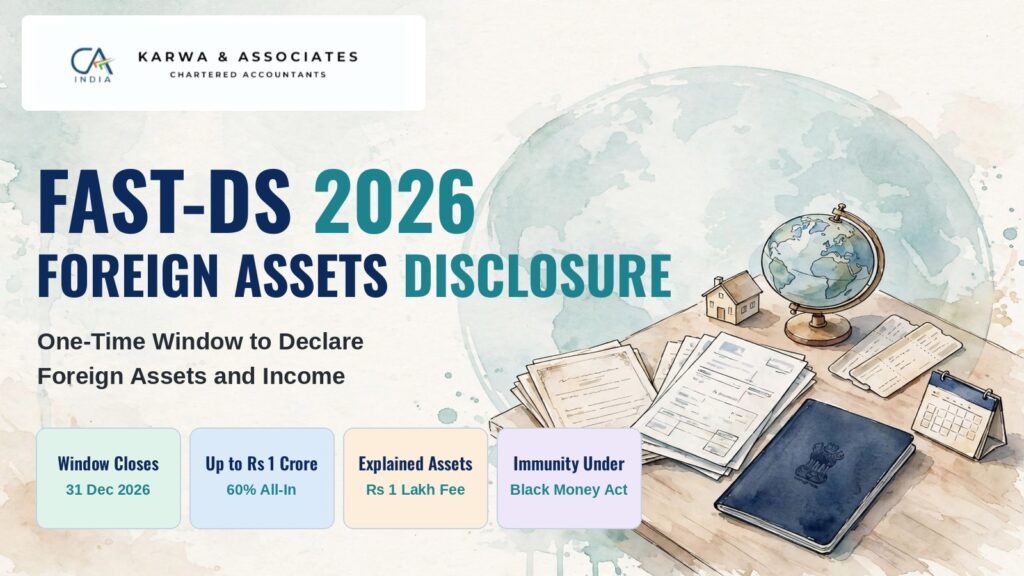
Many Indians hold a foreign asset they never reported: a bank account left open after a student year abroad, ESOPs or RSUs from a foreign employer, a 401(k) left behind after moving back, or a small property bought overseas. FAST-DS 2026 is the Government’s one-time window to bring such assets and income on record, pay a defined amount, and close the matter under the Black Money Act.
The window is short: declarations can be filed only between 16 August 2026 and 31 December 2026. This guide explains who can use FAST-DS 2026, what it costs, how valuation works, which forms and deadlines apply, and what immunity you get, and what you do not.
Read the primary documents first: the CBDT’s official FAQs and the scheme Rules, notified as Notification No. 114/2026 (G.S.R. 732(E)). Every figure here comes from the Finance Act, 2026, those Rules and the FAQs.
Table of Contents
FAST-DS 2026 Basics: What the Scheme Is
1. What is FAST-DS 2026? The Foreign Assets of Small Taxpayers Disclosure Scheme, 2026 is a one-time voluntary disclosure scheme. It lets an eligible taxpayer declare a foreign asset located outside India, or foreign income never offered to tax or reported in a return. The taxpayer pays the prescribed amount and gets immunity from further tax, penalty and prosecution under the Black Money Act, 2015 for what was declared.
2. What is the legal basis? The scheme sits in Chapter IV of the Finance Act, 2026, sections 130 to 144. The working rules are the Foreign Assets of Small Taxpayers Disclosure Scheme Rules, 2026, notified as Notification No. 114/2026 dated 14 August 2026 (G.S.R. 732(E)) under section 143, in force from 16 August 2026.
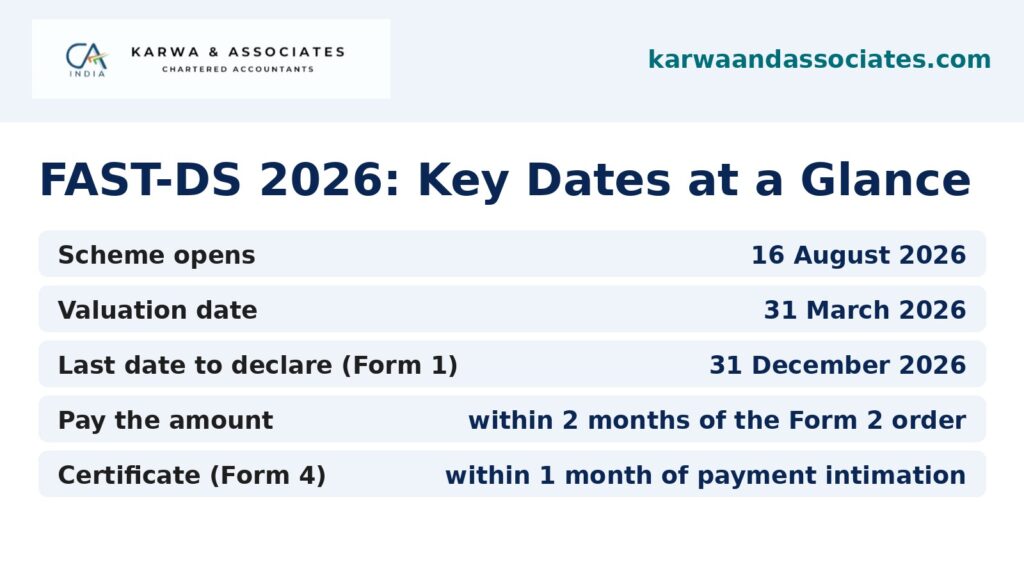
3. What are the key dates? The window runs from 16 August 2026 to 31 December 2026, and all assets are valued as on 31 March 2026. Payment and the certificate follow a fixed timetable, set out next.
FAST-DS 2026 Key Dates You Cannot Miss
Every FAST-DS 2026 date below comes from the Rules and the CBDT FAQs. The filing deadline is fixed. The later dates run off the month you file or receive the order, so file early if you can.
| Event | Date or deadline |
|---|---|
| Scheme announced in the Union Budget 2026-27 | 1 February 2026 |
| Rules notified (Notification No. 114/2026, G.S.R. 732(E)) | 14 August 2026 |
| Declaration window opens | 16 August 2026 |
| Valuation date for all assets | 31 March 2026 |
| Last date to file the declaration (Form 1) | 31 December 2026 |
| Authority’s order of the amount payable (Form 2) | Within one month from the end of the filing month |
| Payment of the amount in the Form 2 order | Within two months from the end of the month the order is received |
| Late payment window | Up to two further months, at simple interest of 1 percent per month or part of a month |
| Outer limit for payment | Four months from the end of the month of the Form 2 order; later payment loses the benefit |
| Intimation of payment (Form 3) | Within the period allowed for payment |
| Certificate (Form 4) | Within one month from the end of the month the Form 3 intimation is received |
FAST-DS 2026 Eligibility: Who Can Declare
The test is about residence, not income. A person can declare if resident in India, under section 6 of the Income-tax Act, 1961, in the relevant previous year. A person who is now a non-resident, or resident but not ordinarily resident (RNOR), can also declare, if he or she was resident in India in the year the income arose, or in the year the asset was acquired.
That is why relocated NRIs are covered: an NRI who earned the income or bought the asset while resident does not lose the scheme because he or she lives abroad today, as the CBDT FAQs confirm.
A declaration can cover any previous year: you did not file a return, or you filed but left the asset or income out of it, or the income escaped assessment. There is no cut-off year and no income test; the word small is enforced only through the value ceilings below.
One honest caution. The law speaks of a person meeting residence conditions, and the FAQs discuss individuals. Whether a company or firm can itself be a declarant is not stated in those terms, so entities should take specific advice first.
FAST-DS 2026 Costs: What You Pay Under Each Route
There is no single fixed charge. Section 133 sets two routes, and which one applies depends on whether the source of the asset or income can be explained.
| Route | What it covers | What you pay | Ceiling |
|---|---|---|---|
| Sl. No. 1 | An undisclosed asset located outside India, or undisclosed foreign income, with no satisfactory explanation of the source | Tax at 30 percent of the asset value as on 31 March 2026, or of the income, plus an additional amount equal to 100 percent of that tax (60 percent effective) | Aggregate of asset value and foreign income does not exceed Rs 1 crore |
| Sl. No. 2 | A foreign asset whose source is explained: acquired from income earned outside India while non-resident, or from income already offered to tax in India, but not shown in the relevant Schedule of the return | A flat fee of Rs 1,00,000 | Value of the asset does not exceed Rs 5 crore |
The Rules’ worked example uses a foreign bank account of Rs 60 lakh plus undisclosed foreign income of Rs 20 lakh. The total of Rs 80 lakh sits within the Rs 1 crore ceiling: tax at 30 percent is Rs 24 lakh, the additional amount is another Rs 24 lakh, and the declarant pays Rs 48 lakh in all.
Above the ceilings, there is no partial use: the Rules’ example of two explained assets of Rs 2.5 crore and Rs 4 crore crosses the Rs 5 crore ceiling in aggregate, so the scheme is unavailable.
FAST-DS 2026 Valuation Rules as on 31 March 2026
Every asset is valued as on 31 March 2026, in Indian rupees, converted at the RBI reference rate for that date, with other currencies routed through US dollars.
The general rule is the higher of cost of acquisition and the open-market price on the valuation date; absent a market valuation, indexed cost is taken as the value. For quoted shares and securities, take the higher of cost and the average of the lowest and highest quoted prices on 31 March 2026, or the nearest trading day before it.
Bank accounts follow a special rule, and it catches people out. The value is the sum of all deposits made from the day the account was opened until 31 March 2026, not the balance on that date. Deposits made out of withdrawals from the same account are left out, so the same money is not counted twice. If the account was declared and taxed earlier under the Black Money Act, only later deposits count.
Assets sold before the valuation date are valued at the higher of cost and sale price. Where sale proceeds were used to buy another asset, the first asset’s value is reduced by the amount reinvested.
One safeguard covers honest differences: for assets other than a bank account, if your declared value and the authority’s value differ by not more than 20 percent, the declaration is not invalid merely for that difference.
FAST-DS 2026 Exclusions: Who Cannot Use the Scheme
Section 140 of the Act lists only two exclusions. The scheme does not apply to income or assets that represent proceeds of crime, where proceedings under the Prevention of Money-laundering Act, 2002 have been initiated or are pending. It also does not apply where assessment under the Black Money Act has already been completed for that year.
Notice what is not excluded. A pending notice or assessment under the Black Money Act or the Income-tax Act does not bar a declaration. Under section 141, the Assessing Officer must take your declaration into account while finalising a pending assessment. Only a completed Black Money Act assessment shuts the door, along with the value ceilings already described.
FAST-DS 2026 Step by Step: How to File the Declaration
The process is fully online, administered by the Principal Director General of Income-tax (Systems): four forms and one challan.
Step 1: File Form 1 on the e-Filing portal. The declaration is filed electronically between 16 August and 31 December 2026, with PAN and passport details. Upload supporting documents: evidence of how the asset was acquired or the income earned, and a valuation report where one is needed, such as for property, jewellery, artistic work or unquoted shares. Several assets and income items can go into one Form 1, verified by digital signature where that applies, otherwise by EVC.
Step 2: Receive the Form 2 order stating the amount payable, within one month from the end of the month you filed.
Step 3: Pay through challan ITNS 289. Payment is made through e-Pay Tax using challan ITNS 289, with assessment year 2026-27 pre-filled. Check every field first: the Department’s manual warns that a wrong-head payment cannot be corrected, and no refund is permitted. Our advance tax calculator can help plan this payment.
Step 4: Intimate the payment in Form 3, with proof of payment, including any interest, within the period allowed for payment.
Step 5: Receive the Form 4 certificate. The authority issues Form 4, certifying the validity of the declaration and the payment, within one month from the end of the month your Form 3 was received. The certificate is conclusive; keep it permanently as proof of closure.
The Rules illustrate this with a Form 2 order passed on 22 September 2026: payment by 30 November 2026 carries no interest, payment on 17 December 2026 costs 1 percent extra, and on 23 January 2027, 2 percent extra. Payment on 5 February 2027 is past the outer limit of 31 January 2027; the benefit is lost.
FAST-DS 2026 Immunity: What You Get and What You Do Not
For what you declare and pay for, section 139 grants immunity from any further tax and penalty under the Black Money Act, 2015, and from prosecution under that Act, for the previous year ending 31 March 2026 and every earlier year. Separately, section 136 keeps the declared income, or the amount invested in the declared asset, out of your total income under the Income-tax Act.
Read the limits carefully. The scheme regularises the tax position only. It says nothing about the Foreign Exchange Management Act, 1999, so a holding that also breaches FEMA is not cured by a declaration. There is no immunity under the PMLA or any other law, and immunity covers only what you declared; anything left out stays exposed.
Three more conditions matter. Amounts paid are never refundable (section 138). A declaration with any material particular found false at any stage is invalid (section 134(3)) and earns no immunity. And declaring does not reopen the past (section 137): no rectification or revision of a completed assessment, and no set-off in an appeal.
What Happens If You Miss the 31 December 2026 Deadline
Once FAST-DS 2026 closes, no declaration can be filed at all. What remains is the full Black Money Act, 2015 regime: a flat 30 percent tax, and penalty of three times the tax, so tax and penalty together take 120 percent of the value.
Separately, a resident who fails to furnish a return, or fails to disclose a foreign asset or income in Schedule FA, faces a penalty of Rs 10 lakh. Prosecution sits behind that: wilful evasion carries rigorous imprisonment of three to ten years, and failure to furnish or disclose carries six months to seven years.
Do not count on the asset staying invisible. India receives financial account information under CRS and FATCA. Press reports in October 2026 said the Department had enabled taxpayers to view foreign asset information reported against their PAN for 2022 to 2024 on the e-Filing portal, was nudging holders of undeclared assets, and that about 1,100 declarations had been filed by late October.
One relief exists outside the scheme. The Finance Act, 2026 decriminalised small holdings with effect from 1 October 2024: prosecution for failure to furnish or disclose does not apply where assets other than immovable property do not exceed Rs 20 lakh in aggregate. That removes prosecution risk only, not tax or penalty.
FAST-DS 2026 and Your Situation: A Short Jaipur Note
Karwa & Associates is based in Jaipur and serves clients across India and globally. Foreign asset cases usually turn on paperwork: bank statements from the year the account was opened, allotment letters for ESOPs, and foreign tax records. Collect these before you file, because Form 1 needs evidence and valuation support, and the window does not extend for missing documents.
If your residence status changed across the years involved, take advice on your specific facts before filing. Readers handling withholding on foreign payments can use our TDS rates chart FY 2026-27; those tracking wider 2026 changes may read our guide to the GST amendments effective 1 November 2026.
FAST-DS 2026 FAQs
What is FAST-DS 2026?
FAST-DS is the Foreign Assets of Small Taxpayers Disclosure Scheme, 2026, a one-time voluntary scheme in Chapter IV of the Finance Act, 2026. Declare assets or income never taxed or reported, pay the prescribed amount, and get immunity under the Black Money Act.
When does the window close?
31 December 2026. Form 1 filing runs from 16 August 2026, and nothing can be filed after the last date; payment and the Form 4 certificate follow the dates table above.
Who can file, and can an NRI declare?
Anyone resident in India in the year the income arose or the asset was acquired can file, for any previous year, including non-residents and RNORs today, such as relocated NRIs. There is no income test; only the ceilings apply.
What does it cost if my foreign account has Rs 40 lakh?
If the source cannot be explained, tax at 30 percent is Rs 12 lakh, plus an additional amount equal to the tax: Rs 24 lakh in total, 60 percent of value, on all deposits since the account opened.
What if my ESOPs were allotted when I was non-resident and already taxed?
The second route: an asset acquired from income earned abroad while non-resident, or from income already taxed in India, but left out of the return’s Schedule, can be declared for a flat Rs 1 lakh fee, within Rs 5 crore.
What is the valuation date?
31 March 2026, for every asset and for testing the ceilings, at the RBI reference rate for that date.
How is a foreign bank account valued?
On deposits, not balance: every deposit from the day the account opened to 31 March 2026, excluding deposits funded by withdrawals from the same account. If taxed under an earlier declaration, only later deposits count.
Can I file if I have received a Black Money Act notice?
Yes. A pending notice or assessment does not bar a declaration; the Assessing Officer must take it into account while finalising the assessment. Only a completed Black Money Act assessment for that year, or PMLA proceedings on proceeds of crime, bars you.
How do I pay?
Through e-Pay Tax using challan ITNS 289, after the Form 2 order states the amount; assessment year 2026-27 is pre-filled. A wrong-head payment on this challan cannot be corrected or refunded.
Is the fee refundable if my declaration is rejected?
No. Section 138 says no amount paid under the scheme is refundable, so check everything before money moves.
Does FAST-DS also settle FEMA?
No. It regularises the tax position under the Black Money Act and the Income-tax Act only, with no immunity under FEMA, the PMLA or any other law.
What if I do nothing?
The asset stays under the Black Money Act: 30 percent tax, penalty of three times the tax, Rs 10 lakh for not disclosing in Schedule FA, and prosecution in serious cases, with CRS and FATCA data flowing to the Department.
Useful Official Links
- CBDT FAQs on FAST-DS 2026 (Income Tax Department)
- FAST-DS Rules, 2026: Notification No. 114/2026 (G.S.R. 732(E)) (Gazette text)
- ITNS 289 e-Pay Tax user manual (Income Tax Department)
- e-Filing portal (Form 1 filing and AEOI information)
About the Author
This guide is prepared and maintained by Karwa & Associates, Chartered Accountants, a Jaipur based firm established in 1991. The firm serves clients across India and globally in taxation, accounting, audit and business advisory.
Disclaimer: This article is general information on the Foreign Assets of Small Taxpayers Disclosure Scheme, 2026 under the Finance Act, 2026, and is not a substitute for advice on your specific facts. Verify figures, forms and deadlines on the e-Filing portal and in the CBDT FAQs before you file or pay.