
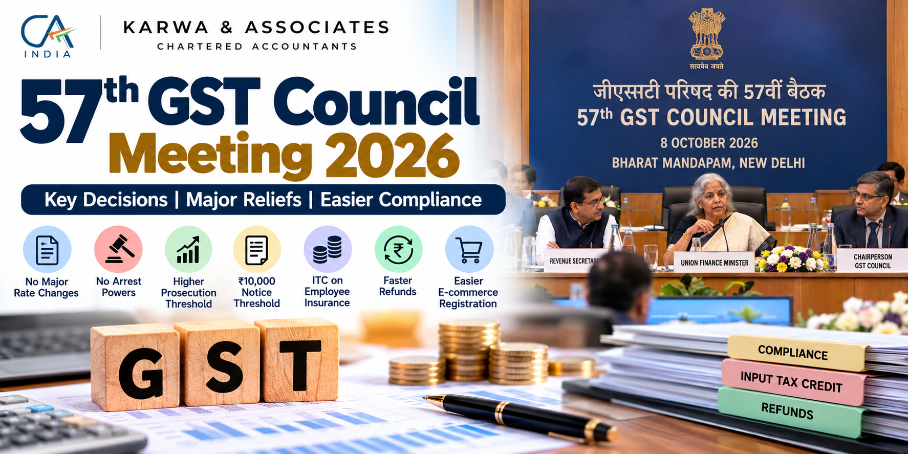
The 57th GST Council Meeting 2026 was held on 8 October 2026 at Bharat Mandapam, New Delhi, under the chairmanship of Union Finance Minister Nirmala Sitharaman. This meeting was different from the earlier GST rate-focused discussions.
The main focus was on making GST compliance simpler, reducing unnecessary litigation, improving Input Tax Credit, speeding up refunds and making enforcement more proportionate. The biggest message from the 57th GST Council Meeting 2026 is clear:
GST reforms are now moving beyond rates and towards better administration and easier compliance.
According to reports following the meeting, several important reforms have been approved or recommended.
Table of Contents
- Major decisions of the 57th GST Council Meeting 2026
- No major GST rate changes
- GST arrest powers to be removed
- Prosecution threshold increased
- ₹10,000 threshold for GST notices
- ITC on employee insurance
- Section 16(2)(c) ITC issue
- Faster GST refunds
- Easier GST registration for e-commerce sellers
- 5% GST on specified delivery services
- Faceless CGST administration
- Standardised GST notices and proceedings
- What businesses should do now
- Conclusion
Major Decisions of the 57th GST Council Meeting 2026
Here are the key decisions:
| Particulars | Key Decision |
|---|---|
| GST rates | No broad rate changes |
| Arrest powers | GST officers’ arrest powers proposed to be removed |
| Prosecution | Threshold reported as increased from ₹1 crore to ₹5 crore |
| GST notices | ₹10,000 monetary threshold |
| Employee insurance | ITC allowed, subject to conditions |
| GST refunds | Acknowledgement timeline reduced from 15 days to 10 days |
| E-commerce sellers | Easier registration mechanism |
| Delivery services | GST reduced to 5% for specified services by unregistered riders |
| Faceless GST | Government plans faceless CGST administration |
| GST notices | Common standards recommended |
| Section 16(2)(c) | Matter referred to officers’ committee for further examination |
| GST rates review | Rate matters proposed to be taken up once a year |
The broad direction of the 57th GST Council Meeting 2026 is towards simpler compliance and more technology driven GST administration.
1. No Major GST Rate Changes
The 57th GST Council Meeting 2026 did not bring any broad GST rate changes.
This is important for businesses because there was considerable speculation about another round of GST rate changes.
The government has indicated that rate-related matters will generally be considered once a year.
This can provide businesses with greater certainty for:
- Pricing
- Contracts
- Budgeting
- Working capital planning
- Inventory valuation
- Long-term business decisions
Reuters has also reported that no GST rates were changed at this meeting.
2. GST Officers’ Arrest Powers to be Removed
This is one of the biggest announcements from the 57th GST Council Meeting 2026.
The Council has approved a proposal to remove the arrest power of GST officers.
Currently, Section 69 of the CGST Act allows the Commissioner to authorise arrest in specified cases where the statutory conditions are satisfied.
The proposed reform aims to move GST enforcement towards a more proportionate system.
In simple terms:
- Routine GST disputes should not result in arrest.
- Normal tax recovery should continue through GST proceedings.
- Interest and applicable penalties will continue.
- Serious criminal cases can still be dealt with under prosecution provisions.
Any change to the existing statutory provisions will require the necessary legislative amendments and implementation.
3. GST Prosecution Threshold Increased
The Council has also approved a higher monetary threshold for prosecution.
Reports from Reuters and Financial Express indicate that the threshold is being increased from ₹1 crore to ₹5 crore.
This means the intention is to reserve criminal prosecution for more serious GST offences.
For smaller cases, the focus would generally remain on:
- Recovery of tax
- Interest
- Proportionate penalty
- Civil proceedings
This is an important shift because not every GST dispute is necessarily a case of deliberate tax evasion.
Important note on the ₹10 crore figure
Some post-meeting reports have mentioned ₹10 crore instead of ₹5 crore.
Since this is a professional tax article, I recommend using ₹5 crore in the published version until the final official legislative text clearly confirms otherwise.
4. No GST Show Cause Notice Below ₹10,000
Another important decision of the 57th GST Council Meeting 2026 is the proposed ₹10,000 monetary threshold for GST show cause notices.
The objective is simple:
Small-value disputes should not result in lengthy departmental proceedings and unnecessary litigation.
This can help both taxpayers and the tax department.
For taxpayers, it may mean:
- Fewer low-value notices
- Lower compliance costs
- Less professional time spent on minor matters
- Reduced litigation
For the department, the focus can shift towards cases involving significant revenue or genuine tax evasion.
TaxScan has reported a ₹10,000 threshold and withdrawal of issued notices within the specified threshold as part of the Council’s recommendations. Studyfromnotes
The detailed rules will determine how the ₹10,000 limit will actually be applied.
5. ITC Allowed on Employee Insurance Expenses
The 57th GST Council Meeting 2026 has also brought relief for employers regarding employee insurance.
Eligible GST paid by employers on employee insurance is proposed to qualify for Input Tax Credit, subject to applicable conditions.
This is particularly relevant for companies providing:
- Group health insurance
- Group life insurance
- Employee insurance benefits
Earlier, restrictions on ITC could make such insurance more expensive for businesses.
With eligible ITC, the GST component can potentially be utilised against output GST liability.
This can reduce the effective cost of employee insurance for eligible businesses.
6. Section 16(2)(c): Genuine Buyer’s ITC Issue Still Not Finally Decided
Section 16(2)(c) has been one of the biggest areas of concern for genuine GST taxpayers.
The basic problem is this:
A buyer may:
- Have a genuine tax invoice
- Receive the goods or services
- Pay the supplier
- Record the transaction properly
But if the supplier fails to pay the tax to the Government, the recipient can face ITC consequences.
The 57th GST Council Meeting 2026 discussed this issue in detail.
However, the Council did not finally amend the provision at this meeting.
An officers’ committee has been proposed to examine the issue further and submit its report within three months.
Therefore, taxpayers should not assume that Section 16(2)(c) has already been changed.
The final decision is expected after further examination by the officers’ committee.
Why this matters
This issue is extremely important for businesses because genuine recipients should ideally not suffer indefinitely because of a supplier’s default.
At the same time, the system must protect against:
- Fake invoices
- Fake suppliers
- Circular trading
- Collusive transactions
- Fraudulent ITC claims
The final amendment will therefore be very important.
7. GST Refund Acknowledgement Time Reduced to 10 Days
The 57th GST Council Meeting 2026 also focuses on improving GST refunds.
The acknowledgement timeline for refund applications has been proposed to be reduced:
Previous timeline: 15 days
New proposed timeline: 10 days
Faster processing can be particularly useful for exporters and businesses with significant accumulated ITC.
Delayed refunds can block working capital.
A faster system can help businesses maintain better cash flow and reduce the cost of financing.
Reports also indicate a greater move towards automated and risk-based processing of refund claims.
8. Easier GST Registration for Small E-Commerce Sellers
Small businesses selling through e-commerce platforms are another major beneficiary of the reform package.
The GST Council has approved easier registration norms for small sellers operating through e-commerce platforms.
The objective is to reduce unnecessary compliance requirements when small businesses want to sell across multiple States.
This can particularly benefit:
- Small manufacturers
- Home businesses
- MSMEs
- Online retailers
- Small service providers
- Sellers using marketplaces
The reform is part of the broader GST 2.0 objective of reducing compliance costs and making GST registration more technology-driven.
9. GST on Specified E-Commerce Delivery Services Reduced to 5%
The 57th GST Council Meeting 2026 has also approved a 5% GST rate for specified delivery services provided by unregistered delivery partners through e-commerce platforms.
This addresses the GST treatment of delivery services in the digital commerce ecosystem.
The change is especially relevant for:
- E-commerce platforms
- Delivery partners
- Logistics businesses
- Quick commerce businesses
The applicable conditions and exact scope should be checked after the relevant notification or amendment is issued.
10. Faceless CGST Administration
The government also intends to introduce faceless administration under Central GST.
The objective is to reduce unnecessary physical interaction between taxpayers and tax officers.
A technology-driven system can potentially provide:
- Better transparency
- Less physical interaction
- More standardisation
- System-based case allocation
- Faster processing
- Better tracking of proceedings
The success of the system will depend on proper safeguards, especially for personal hearings, technical problems, corrections and appeals.
11. Common Standards for GST Notices and Proceedings
Another important reform relates to GST notices.
The Council has recommended common standards for notices and proceedings.
This is important because taxpayers can sometimes face different approaches for similar issues across different jurisdictions.
Standardised procedures can improve consistency in:
- Notice drafting
- Communication of allegations
- Opportunity of hearing
- Adjudication
- Passing of orders
- Documentation
For GST professionals, this could make departmental proceedings easier to analyse and respond to.
12. What Does the 57th GST Council Meeting 2026 Mean for Businesses?
The reforms can be understood in four simple areas.
For MSMEs
The likely benefits include:
- Easier GST registration
- Fewer low-value notices
- Simplified e-commerce compliance
- Reduced litigation burden
- Better working capital management
For large companies
Large businesses may benefit from:
- Employee insurance ITC
- Faster refunds
- Faceless administration
- Greater consistency in GST proceedings
- More proportionate enforcement
For exporters
The major area to watch is faster GST refund processing.
Faster refunds can directly improve working capital.
For GST professionals
The reforms could change the nature of GST litigation.
The focus may gradually move from routine compliance disputes towards:
- Genuine fraud cases
- ITC disputes
- Classification disputes
- Complex valuation matters
- Interpretation of new provisions
13. What Taxpayers Should Do Now
Taxpayers should not immediately change their GST accounting or return-filing practices only because the GST Council has made recommendations.
Before implementing any change, wait for:
- CGST Act amendments
- State GST amendments, where required
- Notifications
- Circulars
- Rule amendments
- GST portal changes
- Effective-date notifications
This is especially important for:
- Employee insurance ITC
- Section 16(2)(c)
- Arrest provisions
- Prosecution provisions
- ₹10,000 notice threshold
- Refund changes
- E-commerce registration
The GST Council makes recommendations, but the actual legal effect depends on the subsequent statutory and administrative implementation.
14. 57th GST Council Meeting 2026, Key Takeaways
In simple words, the 57th GST Council Meeting 2026 is mainly about making GST easier to operate.
The five most important takeaways are:
1. Less coercive enforcement
Arrest powers of GST officers are proposed to be removed.
2. Criminal action reserved for serious cases
The prosecution threshold has been reported as moving from ₹1 crore to ₹5 crore.
3. Less litigation
A ₹10,000 threshold has been approved for GST show cause notices.
4. Better ITC and refunds
Employee insurance ITC and faster refund processing are among the major reforms.
5. Easier compliance
Small e-commerce sellers, GST registration and GST proceedings are being simplified.
Conclusion
The 57th GST Council Meeting 2026 is important because the focus has shifted from changing GST rates to improving the way GST actually works.
The major reforms cover:
- Input Tax Credit
- GST refunds
- GST registration
- E-commerce
- GST notices
- Prosecution
- Arrest powers
- Faceless administration
- Ease of doing business
For taxpayers, the real benefit will depend on how quickly these recommendations are converted into amendments, notifications and GST portal changes.
The Section 16(2)(c) issue will also remain particularly important because the officers’ committee has been given time to examine the issue before the matter comes back to the Council.
Overall, the 57th GST Council Meeting 2026 signals a move towards a more technology-driven, proportionate and taxpayer-friendly GST administration, while retaining stronger action against serious tax fraud.
Read/Download the Official Press Release on Details of changes proposed by GST Council in its 57th meeting:
About the Author
CA Anshul Karwa is a Chartered Accountant and tax professional based in Jaipur, Rajasthan, specialising in GST, Income Tax, tax litigation and business compliance.
This article has been prepared for informational and educational purposes based on the decisions and information available regarding the 57th GST Council Meeting held on 8 October 2026.