
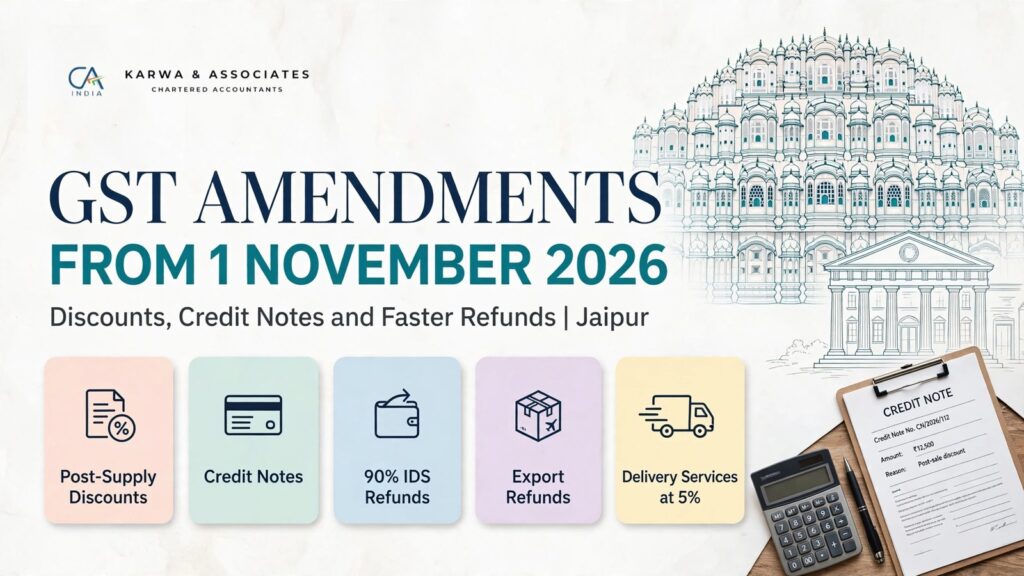
From 1 November 2026, six GST changes take effect together: post-supply discounts no longer need a prior agreement, credit notes get an express legal ground, inverted duty refunds become eligible for a 90 percent provisional refund, input services credit enters the inverted duty refund formula, the Rs 1,000 minimum threshold for export refunds goes, and the tax liability for delivery services sold through e-commerce operators is rewritten.
This guide explains each change with the section, the notification and a worked example, and separates what is law from what is still only a GST Council recommendation.
| Change | Provision | Effective from |
|---|---|---|
| Post-supply discounts without prior agreement or invoice linkage | Section 15(3)(b), CGST Act, substituted by Section 153 of the Finance Act, 2026 | 1 November 2026 |
| Credit notes expressly allowed for post-supply discounts | Section 34(1), amended by Section 154 of the Finance Act, 2026 | 1 November 2026 |
| 90 percent provisional refund extended to inverted duty structure claims | Section 54(6), amended by Section 155 of the Finance Act, 2026 | 1 November 2026 |
| Input services credit enters the inverted duty refund formula; capital goods credit follows in April 2027 | Rule 89(5), substituted by Notification No. 05/2026-Central Tax | 1 November 2026 and 1 April 2027 |
| Rs 1,000 minimum refund threshold removed for exports of goods with payment of tax | Section 54(14), amended by Section 155 of the Finance Act, 2026 | 1 November 2026 |
| Delivery services through e-commerce operators: liability rewritten, rate cut to 5 percent without ITC | Section 9(5) notifications No. 09/2026-Central Tax (Rate) and No. 06/2026-Central Tax (Rate) | 1 November 2026 |
| Rule 14B registration option for sellers supplying through e-commerce operators | Rule 14B, inserted by Notification No. 05/2026-Central Tax | 1 November 2026 |
Table of Contents
Official notifications behind the GST amendments 1 November 2026
The commencement document is Notification No. 03/2026-Central Tax dated 26 October 2026 (S.O. 5791(E)), which appoints 1 November 2026 as the date on which Sections 153 to 155 of the Finance Act, 2026 come into force.
The rule changes sit in Notification No. 05/2026-Central Tax dated 26 October 2026, which issues the CGST (Amendment) Rules, 2026. The delivery services changes sit in Notification No. 09/2026-Central Tax (Rate) and the matching Notification No. 09/2026-Integrated Tax (Rate), both dated 27 October 2026, with the rate set by Notification No. 06/2026-Central Tax (Rate) dated 27 October 2026. Read the post with these references open; every section below names its source. All of these notifications are published by the Central Board of Indirect Taxes and Customs and can be read on the CBIC website and filed or tracked through the GST portal.
GST amendments 1 November 2026 for post-supply discounts (Section 15(3)(b))
Until 31 October 2026, a discount given after supply could be excluded from the value of supply only if it was established under an agreement entered into at or before the time of supply, was specifically linked to the relevant invoices, and the recipient reversed the input tax credit attributable to it. The first two conditions caused most of the disputes: genuine commercial discounts failed on paperwork, not on substance.
The substituted Section 15(3)(b) drops both conditions. From 1 November 2026, a post-supply discount is excluded from the value of supply if the supplier issues a credit note for it under Section 34 and the recipient reverses the input tax credit attributable to the discount.
Worked example. A supplier sells goods for Rs 5,00,000 plus GST at 18 percent (Rs 90,000). After the supply, it grants a discount of Rs 50,000 on the value. The GST on the discount is Rs 9,000, so the credit note is issued for Rs 59,000.
The supplier’s taxable value falls by Rs 50,000, and the recipient reverses Rs 9,000 of input tax credit. Before this amendment, the same discount would have failed if there was no pre-supply agreement recording it or if the credit note could not be linked invoice by invoice. From 1 November 2026, the credit note and the reversal are the whole test.
Two cautions. First, the credit note must still be reported within the time limit Section 34 prescribes, which is the 30th day of November following the end of the financial year in which the supply was made, or the date of the annual return, whichever is earlier. Second, keep evidence of the recipient’s reversal in your file; the supplier’s reduction depends on it.
GST amendments 1 November 2026 for credit notes (Section 34(1))
Section 34(1) now expressly lists a discount referred to in Section 15(3)(b) as a ground for issuing a credit note. This sounds minor and is not: officers had argued in the past that a credit note could not rest on a post-supply discount that had no prior agreement behind it. The amended text removes that argument.
In practice: report the credit note in GSTR-1, let it flow to the recipient’s GSTR-2B so the reversal is visible, and make the corresponding adjustment in GSTR-3B. Reconcile the credit note against the recipient’s reversal every month. A credit note without a matching reversal is the one fact pattern most likely to be picked up in scrutiny.
GST amendments 1 November 2026 for inverted duty refunds: 90% provisional refund (Section 54(6))
Businesses whose inputs are taxed higher than their output have waited years for inverted duty refunds to move at the speed exporters get. Section 155 of the Finance Act, 2026 amends Section 54(6) so that the provisional refund mechanism, 90 percent of the claim released on a risk basis before detailed scrutiny, now covers eligible unutilised input tax credit under the inverted duty structure category in Section 54(3), in addition to zero-rated supplies.
Worked example. A manufacturer has an eligible inverted duty refund claim of Rs 4,00,000 for a tax period. Under the amended Section 54(6), Rs 3,60,000, which is 90 percent, can be released provisionally, subject to the prescribed conditions and risk-based processing. The balance follows after verification. Before this amendment, the whole Rs 4,00,000 waited for the full scrutiny cycle.
Provisional does not mean automatic. The claim must still be a valid Section 54(3) claim computed under Rule 89(5), and the department can still examine it in detail afterwards. What changes is the cash flow timing, which is the point of the reform.
GST amendments 1 November 2026 for input services and capital goods in Rule 89(5)
Rule 89(5), substituted by Notification No. 05/2026-Central Tax, rewrites what counts as Net ITC in the inverted duty refund formula. Two additions matter:
- Input services. Input tax credit on input services availed on or after 1 November 2026 is included in Net ITC for inverted duty refunds. Credit availed before that date stays out.
- Capital goods. Input tax credit on capital goods availed on or after 1 April 2027 is included, spread over 60 months. Each month, one-sixtieth of the eligible credit is attributable, after deducting applicable reversals.
Worked example. A business buys machinery in April 2027 and avails capital goods credit of Rs 6,00,000. The amount attributable to each month is Rs 10,000 (Rs 6,00,000 divided by 60). For a refund period covering three months, Rs 30,000 of that credit enters the Net ITC computation, subject to the Rule 89(5) formula and to the exclusion of blocked or reversed credit.
One limit has not moved: an inverted duty claim still needs the rate of tax on inputs to be higher than the rate on output supplies. A higher rate on input services alone does not create the claim; it only increases its size once the claim exists.
GST amendments 1 November 2026 for export refunds: the Rs 1,000 threshold goes (Section 54(14))
Section 54(14) said no refund would be granted where the amount was less than Rs 1,000. Section 155 of the Finance Act, 2026 carves exports of goods with payment of tax out of that restriction. From 1 November 2026, a small export refund claim is no longer blocked only because of its size.
This matters most to small and first-time exporters whose early shipments generate small claims that were simply stuck. If you export from Jaipur or anywhere else in India and have small claims pending only because of the threshold, review them now. Our guide to the Rajasthan gems export subsidy covers the state-side support that can sit alongside GST refunds for exporter units.
GST amendments 1 November 2026 for delivery services sold through e-commerce operators (Section 9(5))
Notification No. 09/2026-Central Tax (Rate) substitutes the delivery services entry in the Section 9(5) notification. From 1 November 2026, the entry covers delivery services other than postal and courier services, except where the person supplying the services through the e-commerce operator is liable for registration under Section 22(1). Where the delivery provider is not liable for registration, the e-commerce operator pays the tax as if it were the supplier. Where the provider is liable for registration, the provider pays.
The rate also changes. Notification No. 06/2026-Central Tax (Rate) sets the tax on these delivery services at 5 percent without input tax credit (2.5 percent CGST and 2.5 percent SGST), replacing the earlier 18 percent with credit treatment for local delivery services.
Platforms and sellers should test three things before the November billing run: whether each delivery partner is liable for registration under Section 22(1), because that decides who pays; whether agreements with delivery partners reflect the new liability split; and whether invoicing is set to the 5 percent without ITC rate.
Industry bodies have asked for more time to reconfigure systems, but the notification stands at 1 November 2026 unless a deferral is issued.
One more change that is already law: Rule 14B registration for e-commerce sellers
The infographic summaries of these changes usually file registration under “recommendations”. That is out of date. Notification No. 05/2026-Central Tax inserts Rule 14B with effect from 1 November 2026. It lets a supplier selling goods through an e-commerce operator that collects tax at source under Section 52 obtain registration in another State or Union territory where it has no physical presence, by declaring the operator’s warehouse there as its principal place of business, subject to the conditions in the rule.
Small sellers supplying into other States through marketplace warehouses should examine this route before taking a conventional registration in every State. Our GST registration simplified guide explains the current registration framework these rules amend.
What Jaipur businesses should do before the November filings
For a Jaipur trading or manufacturing business, the November work is specific. Review every discount scheme you run with dealers and distributors: from 1 November, the scheme document no longer decides the GST outcome, the credit note and the customer’s reversal do, so your process for collecting reversal confirmations matters more than the scheme wording. If you carry inverted duty accumulation, rebuild the refund computation for periods from November onwards so input services credit availed from 1 November is captured from day one; claims built on the old formula will leave money behind.
Exporters in the gems and jewellery trade should club the export refund change with the state export promotion benefits already covered on this site. And any business selling through marketplaces should confirm with its operator how Rule 14B and the delivery services changes are being implemented on the platform, in writing.
Recommended by the GST Council, but not yet law
The 57th GST Council meeting on 8 October 2026 recommended more than what has been notified. The following items are recommendations or proposals at the time of writing. They do not change any filing until the law or a notification gives them effect, and some procedural items inside Notification No. 05/2026 carry their own later dates, including 1 December 2026 and 1 April 2027 for specified parts.
- A minimum penalty of Rs 10,000 in specified cases and a higher prosecution threshold of Rs 5 crore: proposed, needs amendment.
- Widening or narrowing of the blocked credit list under Section 17(5): subject to amendment; do not reclassify credits yet.
- Return filing changes such as auto acceptance and a mismatch correction mechanism: recommended; watch for the return notifications and portal changes.
- E-way bill and e-invoice restrictions for unregistered persons, reverse charge and import of services, indicated for 1 January 2027 in Council discussions: not a 1 November change; implementation will depend on separate notifications.
- The 90 percent provisional refund and 10-day acknowledgement framework beyond the inverted duty change already enacted: partly law through Section 54(6) as explained above, partly still recommendation.
The discipline is simple: file November on the six notified changes, and treat everything in this section as a watch list, not a compliance position.
Action checklist
- Before the November invoice run: switch discount documentation to the credit note plus reversal model, and brief your sales and accounts teams that prior agreements are no longer the test.
- Set up a monthly reconciliation of credit notes issued against recipient reversals visible in GSTR-2B.
- Recompute inverted duty refund claims for periods from November 2026 with input services credit availed on or after 1 November included in Net ITC.
- Identify export refund claims previously blocked only by the Rs 1,000 threshold and file them.
- If you sell or deliver through an e-commerce operator: confirm each delivery partner’s registration status under Section 22(1), update agreements, and set billing to 5 percent without ITC for delivery services within the amended entry.
- If you sell through marketplace warehouses in other States, evaluate Rule 14B before taking fresh conventional registrations.
- Diarise 1 April 2027: capital goods credit enters the refund formulas from that date, spread over 60 months, so asset purchase records from April 2027 need clean credit tagging from the start.
FAQs on the GST amendments 1 November 2026
Do post-supply discounts still need a prior agreement after 1 November 2026?
No. The substituted Section 15(3)(b) removes the prior agreement and invoice linkage conditions. The supplier must issue a credit note under Section 34 and the recipient must reverse the attributable input tax credit.
Can a credit note be issued for a discount on a supply made before 1 November 2026?
The amendment operates from 1 November 2026 and the credit note must in any case be within the Section 34 time limit. Transitional cases, where the discount relates to an earlier supply, should be documented carefully; where the amount is significant, take advice before issuing, because the notification does not spell out a separate transition rule.
Who gets the 90 percent provisional refund now?
Eligible inverted duty structure claims under Section 54(3) join zero-rated supplies under the amended Section 54(6), subject to the prescribed conditions and risk-based processing. It is a timing benefit, not a waiver of scrutiny.
Our input services are taxed at 18 percent and our output at 5 percent. Do we get an inverted duty refund?
Only if the rate on your inputs is also higher than the rate on your output supplies. The eligibility test still turns on inputs. If it is met, input services credit availed on or after 1 November 2026 now increases the refund amount.
We deliver through a marketplace. Who pays GST on delivery charges now?
If the delivery provider is not liable for registration under Section 22(1), the e-commerce operator pays under Section 9(5). If the provider is liable for registration, the provider pays. The rate for services within the amended entry is 5 percent without input tax credit, and postal and courier services are outside the entry.
This article is general information on the notified amendments, not advice for a specific transaction. Refund eligibility, sanction and computation depend on your facts and the prescribed conditions; the sanctioning authority decides each claim.
About the Author
Written and reviewed by CA Anshul Karwa, Chartered Accountant (DISA-qualified) associated with Karwa & Associates, Chartered Accountants, Jaipur. Karwa & Associates is based in Jaipur and serves clients across India. For a review of how these amendments affect your November filings, refunds or marketplace arrangements, contact the firm.

CA Anshul Karwa is a Chartered Accountant (DISA-qualified) and Partner at Karwa & Associates, Chartered Accountants, Jaipur. A non-commerce student who cleared CA in the first attempt, he worked with Big 4 firms and MNCs before joining the firm. He also builds digital apps, websites and tools for CAs, founders and other professionals, and writes books on investing.